the base of a solid s is the region bounded by the curve y = e^(-x), the x - axis, the y - axis, and the…
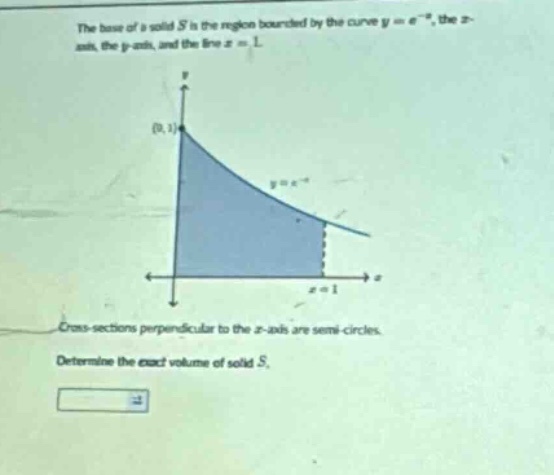
the base of a solid s is the region bounded by the curve y = e^(-x), the x - axis, the y - axis, and the line x = 1. cross - sections perpendicular to the x - axis are semi - circles. determine the exact volume of solid s.
Answer
Explanation:
Step1: Find the radius of the semi - circle cross - section
The diameter of each semi - circular cross - section perpendicular to the x - axis is given by the height of the function (y = e^{-x}) at a particular x. So the radius (r=\frac{y}{2}=\frac{e^{-x}}{2}).
Step2: Find the area formula of the semi - circle cross - section
The area of a semi - circle is (A=\frac{1}{2}\pi r^{2}). Substituting (r = \frac{e^{-x}}{2}) into the formula, we get (A(x)=\frac{1}{2}\pi(\frac{e^{-x}}{2})^{2}=\frac{\pi}{8}e^{-2x}).
Step3: Use the definite integral to find the volume
The volume (V) of the solid with cross - sectional area (A(x)) from (x = 0) to (x = 1) is given by the definite integral (V=\int_{a}^{b}A(x)dx). Here, (a = 0), (b = 1), and (A(x)=\frac{\pi}{8}e^{-2x}). So (V=\int_{0}^{1}\frac{\pi}{8}e^{-2x}dx). Let (u=-2x), then (du=-2dx). When (x = 0), (u = 0); when (x = 1), (u=-2). And (dx=-\frac{1}{2}du). The integral becomes (V=\frac{\pi}{8}\int_{0}^{-2}-\frac{1}{2}e^{u}du=\frac{\pi}{16}\int_{-2}^{0}e^{u}du). Evaluating the integral (\int_{-2}^{0}e^{u}du=e^{u}\big|_{-2}^{0}=e^{0}-e^{-2}=1 - e^{-2}). So (V=\frac{\pi}{16}(1 - e^{-2})).
Answer:
(\frac{\pi}{16}(1 - e^{-2}))