4. the base of a solid is the region in the first quadrant bounded by the graph of $y = 2-\frac{2}{3}x$ and…
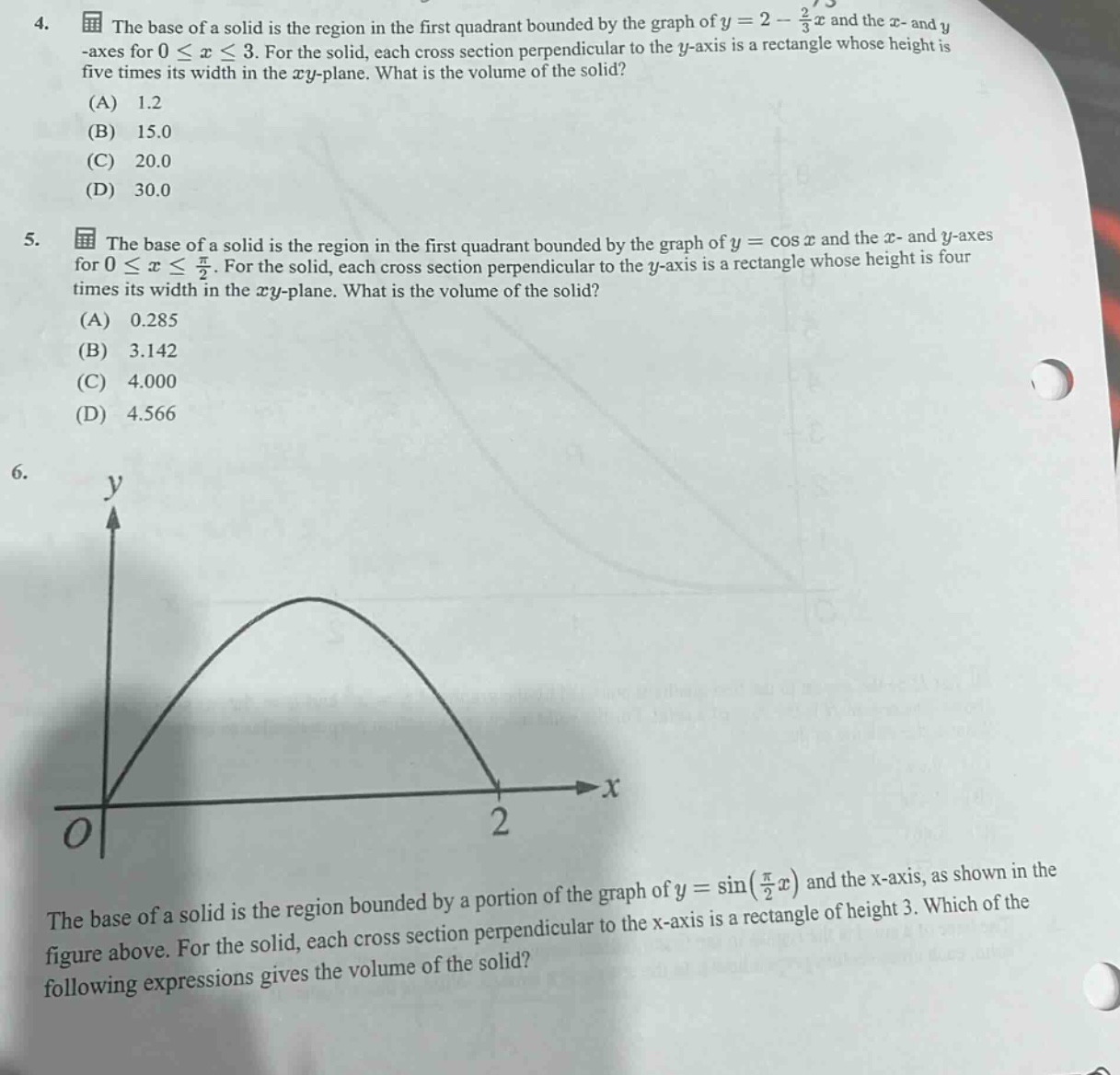
4. the base of a solid is the region in the first quadrant bounded by the graph of $y = 2-\frac{2}{3}x$ and the $x$- and $y$-axes for $0leq xleq3$. for the solid, each cross - section perpendicular to the $y$-axis is a rectangle whose height is five times its width in the $xy$-plane. what is the volume of the solid? (a) 1.2 (b) 15.0 (c) 20.0 (d) 30.0\n5. the base of a solid is the region in the first quadrant bounded by the graph of $y=cos x$ and the $x$- and $y$-axes for $0leq xleq\frac{pi}{2}$. for the solid, each cross - section perpendicular to the $y$-axis is a rectangle whose height is four times its width in the $xy$-plane. what is the volume of the solid? (a) 0.285 (b) 3.142 (c) 4.000 (d) 4.566\n6. the base of a solid is the region bounded by a portion of the graph of $y = sin(\frac{pi}{2}x)$ and the $x$-axis, as shown in the figure above. for the solid, each cross - section perpendicular to the $x$-axis is a rectangle of height 3. which of the following expressions gives the volume of the solid?
Answer
4.
Explanation:
Step1: Rewrite the function for (x) in terms of (y)
Given (y = 2-\frac{2}{3}x), we can solve for (x): (x=\frac{3(2 - y)}{2}=3-\frac{3}{2}y). The limits of integration for (y) are from (y = 0) to (y=2) (when (x = 0), (y=2)). The width of the rectangle (in the (xy -)plane) perpendicular to the (y -)axis is (x), and the height (h) of the rectangle is (5x). The area of the cross - section (A(y)) is (A(y)=h\times x=5x\times x = 5x^{2}). Substituting (x = 3-\frac{3}{2}y) into the area formula, we get (A(y)=5\left(3-\frac{3}{2}y\right)^{2}=5\left(9 - 9y+\frac{9}{4}y^{2}\right)=45-45y+\frac{45}{4}y^{2}).
Step2: Calculate the volume using the integral
The volume (V) of the solid with cross - sectional area (A(y)) is given by the integral (V=\int_{a}^{b}A(y)dy). Here, (a = 0), (b = 2), so (V=\int_{0}^{2}\left(45-45y+\frac{45}{4}y^{2}\right)dy). Using the power rule (\int y^{n}dy=\frac{y^{n + 1}}{n+1}+C(n\neq - 1)), we have (V=\left[45y-\frac{45y^{2}}{2}+\frac{45y^{3}}{12}\right]_{0}^{2}). [ \begin{align*} V&=45\times2-\frac{45\times2^{2}}{2}+\frac{45\times2^{3}}{12}\ &=90 - 90+30\ &=30 \end{align*} ]
Answer:
D. 30.0
5.
Explanation:
Step1: Rewrite the function for (x) in terms of (y)
Given (y=\cos x), then (x = \arccos y). The limits of integration for (y) are from (y = 0) to (y = 1) (when (x = 0), (y=\cos(0)=1) and when (x=\frac{\pi}{2}), (y=\cos(\frac{\pi}{2}) = 0)). The width of the rectangle (in the (xy -)plane) perpendicular to the (y -)axis is (x=\arccos y), and the height (h) of the rectangle is (4x). The area of the cross - section (A(y)) is (A(y)=h\times x=4x\times x=4x^{2}). Substituting (x=\arccos y) into the area formula, we get (A(y)=4(\arccos y)^{2}).
Step2: Calculate the volume using the integral
The volume (V) of the solid with cross - sectional area (A(y)) is given by the integral (V=\int_{a}^{b}A(y)dy). Here, (a = 0), (b = 1), so (V = 4\int_{0}^{1}(\arccos y)^{2}dy). We use integration by parts. Let (u=(\arccos y)^{2}), (dv=dy), then (du=- 2\frac{\arccos y}{\sqrt{1 - y^{2}}}dy), (v=y). [ \begin{align*} \int(\arccos y)^{2}dy&=y(\arccos y)^{2}+2\int\frac{y\arccos y}{\sqrt{1 - y^{2}}}dy \end{align*} ] For (\int\frac{y\arccos y}{\sqrt{1 - y^{2}}}dy), use integration by parts again. Let (u=\arccos y), (dv=\frac{y}{\sqrt{1 - y^{2}}}dy), then (du=-\frac{1}{\sqrt{1 - y^{2}}}dy), (v=-\sqrt{1 - y^{2}}). [ \begin{align*} \int\frac{y\arccos y}{\sqrt{1 - y^{2}}}dy&=-\sqrt{1 - y^{2}}\arccos y-\int 1dy=-\sqrt{1 - y^{2}}\arccos y - y+C \end{align*} ] [ \begin{align*} 4\int_{0}^{1}(\arccos y)^{2}dy&=4\left[y(\arccos y)^{2}+2\left(-\sqrt{1 - y^{2}}\arccos y - y\right)\right]_{0}^{1}\ &=4\left[0 + 2(0 - 1)-0-2(0 - 0)\right]\ &=4 \end{align*} ]
Answer:
C. 4.000
6.
Explanation:
Step1: Determine the area of the cross - section
The base of the solid is bounded by (y = \sin(\frac{\pi}{2}x)) and the (x -)axis with (0\leq x\leq2). Each cross - section perpendicular to the (x -)axis is a rectangle of height (h = 3). The width of the rectangle at a given (x) is (y=\sin(\frac{\pi}{2}x)). The area of the cross - section (A(x)) is (A(x)=h\times y=3\sin(\frac{\pi}{2}x)).
Step2: Calculate the volume using the integral
The volume (V) of the solid with cross - sectional area (A(x)) is given by the integral (V=\int_{a}^{b}A(x)dx). Here, (a = 0), (b = 2), so (V=\int_{0}^{2}3\sin(\frac{\pi}{2}x)dx). Let (u=\frac{\pi}{2}x), then (du=\frac{\pi}{2}dx) and (dx=\frac{2}{\pi}du). When (x = 0), (u = 0); when (x = 2), (u=\pi). [ \begin{align*} V&=3\times\frac{2}{\pi}\int_{0}^{\pi}\sin(u)du\ &=\frac{6}{\pi}[-\cos(u)]{0}^{\pi}\ &=\frac{6}{\pi}(1 + 1)\ &=\frac{12}{\pi}\approx3.82 \end{align*} ] However, we are looking for the expression of the volume. The volume (V=\int{0}^{2}3\sin(\frac{\pi}{2}x)dx)
The volume of the solid is given by the integral (\int_{0}^{2}3\sin\left(\frac{\pi}{2}x\right)dx)
So the answers are: 4. D. 30.0 5. C. 4.000 6. (\int_{0}^{2}3\sin\left(\frac{\pi}{2}x\right)dx)