based on the table, which best predicts the end behavior of the graph of ( f(x) )? as ( x \to infty, f(x)…
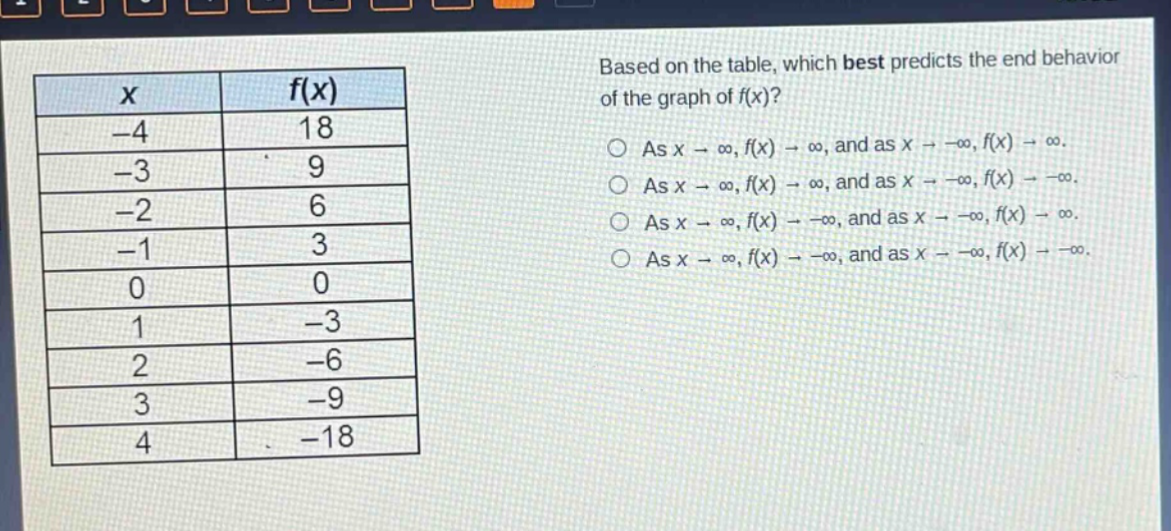
based on the table, which best predicts the end behavior of the graph of ( f(x) )? as ( x \to infty, f(x) \to infty ), and as ( x \to -infty, f(x) \to infty ). as ( x \to infty, f(x) \to infty ), and as ( x \to -infty, f(x) \to -infty ). as ( x \to infty, f(x) \to -infty ), and as ( x \to -infty, f(x) \to infty ). as ( x \to infty, f(x) \to -infty ), and as ( x \to -infty, f(x) \to -infty ).
Answer
Explanation:
Step 1: Analyze sign of ( f(x) ) for large ( |x| )
For ( x = -4, -3, -2 ) (large negative), ( f(x) ) is positive and increasing in magnitude. For ( x = 1, 2, 3, 4 ) (large positive), ( f(x) ) is negative and increasing in magnitude.
Step 2: Determine end behavior based on sign changes
As ( x \to \infty ), ( f(x) \to -\infty ) (negative and unbounded). As ( x \to -\infty ), ( f(x) \to \infty ) (positive and unbounded), consistent with an odd-degree polynomial with negative leading coefficient.
Answer:
As ( x \to \infty ), ( f(x) \to -\infty ), and as ( x \to -\infty ), ( f(x) \to \infty ).