based on the table, which best predicts the end behavior of the graph of f(x)?\nas x → ∞, f(x) → ∞, and as x…
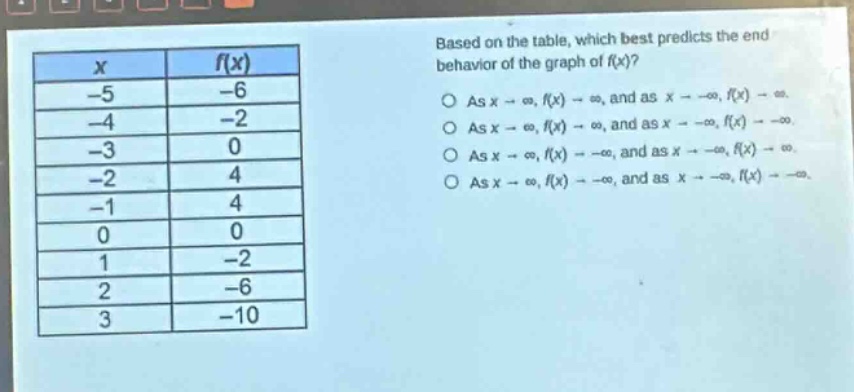
based on the table, which best predicts the end behavior of the graph of f(x)?\nas x → ∞, f(x) → ∞, and as x → -∞, f(x) → ∞.\nas x → ∞, f(x) → ∞, and as x → -∞, f(x) → -∞.\nas x → ∞, f(x) → -∞, and as x → -∞, f(x) → ∞.\nas x → ∞, f(x) → -∞, and as x → -∞, f(x) → -∞.\nx\tf(x)\n-5\t-6\n-4\t-2\n-3\t0\n-2\t4\n-1\t4\n0\t0\n1\t-2\n2\t-6\n3\t-10
Answer
Explanation:
Step1: Analyze x - values approaching positive infinity
As (x) increases from (1) to (3), (f(x)) goes from (- 2) to (-10), indicating a decreasing trend. So as (x\rightarrow\infty), (f(x)\rightarrow-\infty).
Step2: Analyze x - values approaching negative infinity
As (x) decreases from (-1) to (-5), (f(x)) goes from (4) to (-6), also indicating a decreasing trend. So as (x\rightarrow-\infty), (f(x)\rightarrow-\infty).
Answer:
As (x\rightarrow\infty), (f(x)\rightarrow-\infty), and as (x\rightarrow-\infty), (f(x)\rightarrow-\infty)