based on the table, which best predicts the end behavior of the graph of f(x)?\nas x→∞, f(x)→∞, and as x→−∞…
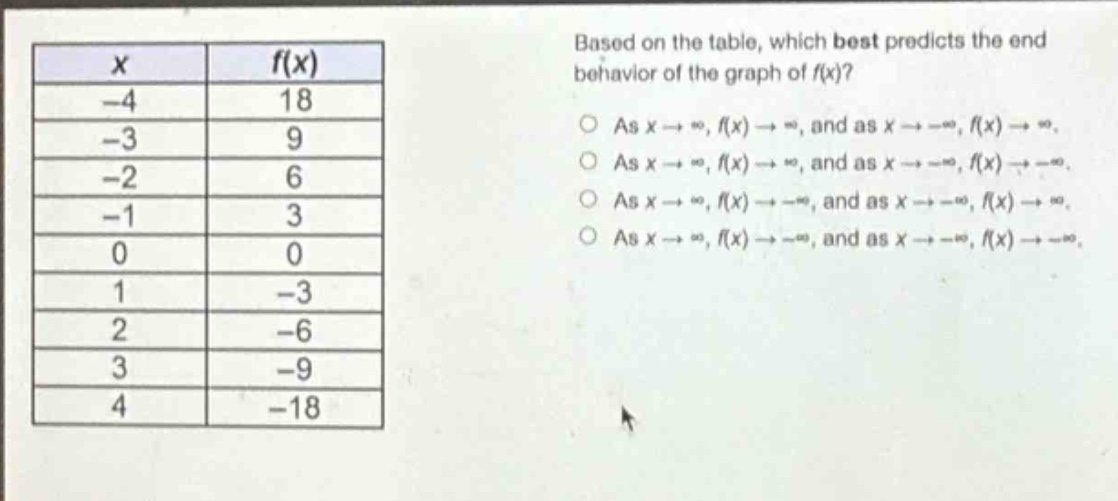
based on the table, which best predicts the end behavior of the graph of f(x)?\nas x→∞, f(x)→∞, and as x→−∞, f(x)→∞.\nas x→∞, f(x)→∞, and as x→−∞, f(x)→−∞.\nas x→∞, f(x)→−∞, and as x→−∞, f(x)→∞.\nas x→∞, f(x)→−∞, and as x→−∞, f(x)→−∞.\n\nx\tf(x)\n−4\t18\n−3\t9\n−2\t6\n−1\t3\n0\t0\n1\t−3\n2\t−6\n3\t−9\n4\t−18
Answer
Explanation:
Step1: Observe x - values and f(x) - values
As x increases from - 4 to 4, f(x) decreases from 18 to - 18.
Step2: Determine end - behavior
As (x\to\infty), (f(x)\to-\infty); as (x\to-\infty), (f(x)\to\infty).
Answer:
As (x\to\infty), (f(x)\to-\infty), and as (x\to-\infty), (f(x)\to\infty)