based on the table, which statement best describes a prediction for the end - behavior of the graph of…
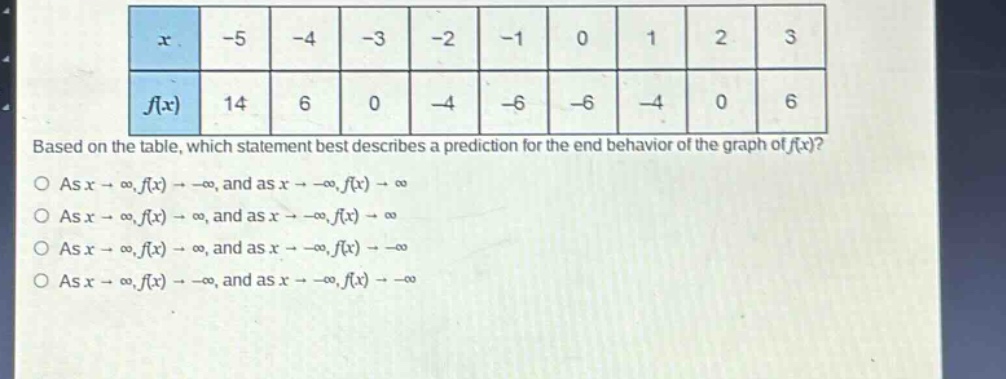
based on the table, which statement best describes a prediction for the end - behavior of the graph of f(x)?\nas (x\toinfty,f(x)\to-infty), and as (x\to-infty,f(x)\toinfty)\nas (x\toinfty,f(x)\toinfty), and as (x\to-infty,f(x)\toinfty)\nas (x\toinfty,f(x)\toinfty), and as (x\to-infty,f(x)\to-infty)\nas (x\toinfty,f(x)\to-infty), and as (x\to-infty,f(x)\to-infty)
Answer
Explanation:
Step1: Analyze positive - x values
As (x) increases from (0) to (3), (f(x)) goes from (- 6) to (6). As (x) continues to increase ((x\rightarrow\infty)), we can observe the upward - trending pattern, so (f(x)\rightarrow\infty).
Step2: Analyze negative - x values
As (x) decreases from (0) to (-5), (f(x)) goes from (-6) to (14). As (x) continues to decrease ((x\rightarrow-\infty)), we can observe the upward - trending pattern, so (f(x)\rightarrow\infty).
Answer:
As (x\rightarrow\infty,f(x)\rightarrow\infty), and as (x\rightarrow-\infty,f(x)\rightarrow\infty)