begin with the graph of ( y = e ^ { x } ). use transformations to graph the function below. then determine…
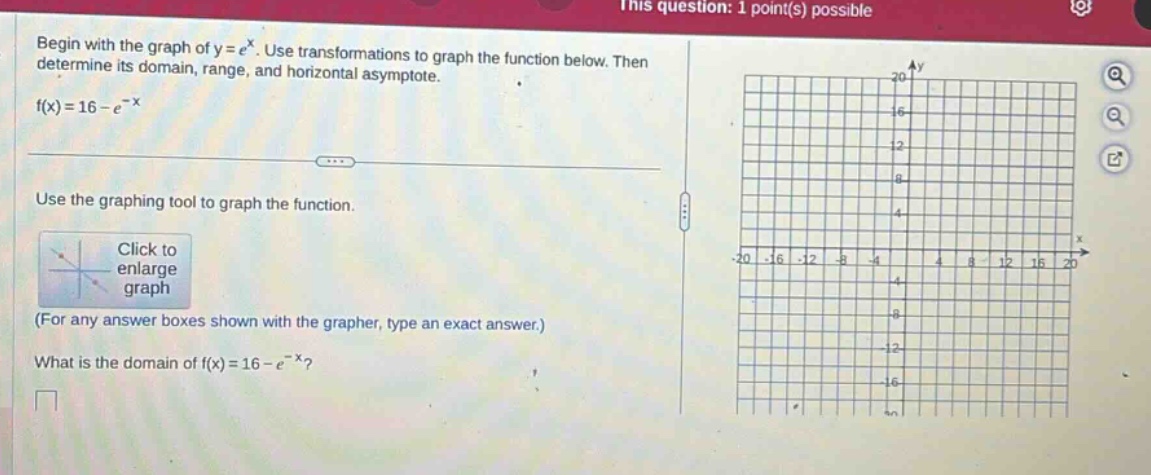
begin with the graph of ( y = e ^ { x } ). use transformations to graph the function below. then determine its domain, range, and horizontal asymptote.\n( f ( x ) = 16 - e ^ { - x } )\nuse the graphing tool to graph the function.\n(for any answer boxes shown with the grapher, type an exact answer.)\nwhat is the domain of ( f ( x ) = 16 - e ^ { - x } )?
Answer
Explanation:
Step 1: Identify base function transformations
Start with ( y = e^x ). Reflect over y-axis: ( y = e^{-x} ). Reflect over x-axis: ( y = -e^{-x} ). Shift up 16 units: ( f(x) = 16 - e^{-x} ).
Step 2: Determine domain
Exponential functions have no restrictions on ( x ).
Domain: All real numbers.
Step 3: Determine range
( e^{-x} > 0 ) for all ( x ), so ( -e^{-x} < 0 ). Adding 16: ( 16 - e^{-x} < 16 ).
Range: ( (-\infty, 16) ).
Step 4: Find horizontal asymptote
As ( x \to \infty ), ( e^{-x} \to 0 ), so ( f(x) \to 16 ).
Horizontal asymptote: ( y = 16 ).
Answer:
Domain: ( (-\infty, \infty) )
Range: ( (-\infty, 16) )
Horizontal Asymptote: ( y = 16 )