begin with the graph of y = e^x and use transformations to graph the function. determine the domain, range…
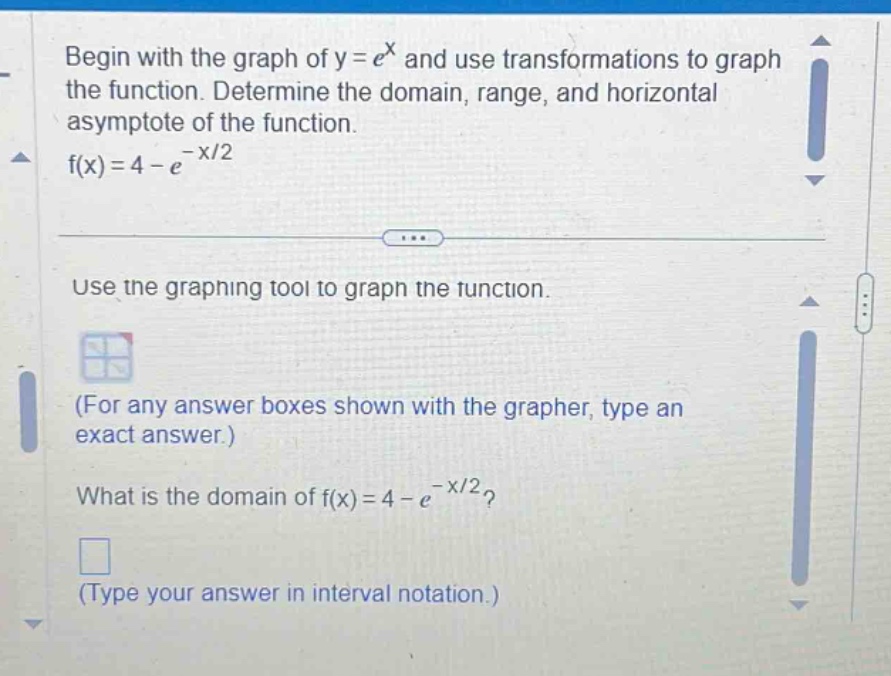
begin with the graph of y = e^x and use transformations to graph the function. determine the domain, range, and horizontal asymptote of the function. f(x)=4 - e^(-x/2) use the graphing tool to graph the function. (for any answer boxes shown with the grapher, type an exact answer.) what is the domain of f(x)=4 - e^(-x/2)? (type your answer in interval notation.)
Answer
Explanation:
Step1: Recall domain of exponential functions
The exponential function $e^{u}$ is defined for all real - valued $u$. In the function $f(x)=4 - e^{-x/2}$, the exponent $u =-\frac{x}{2}$ is a real - valued linear function of $x$. Since $-\frac{x}{2}$ is defined for all real $x$, the domain of $f(x)$ is not restricted by the exponential part.
Step2: Determine the domain
The domain of a function is the set of all possible input values. For the function $f(x)=4 - e^{-x/2}$, $x$ can be any real number. In interval notation, the set of all real numbers is $(-\infty,\infty)$.
Answer:
$(-\infty,\infty)$