begin with the graph of y = e^x and use transformations to graph the function. determine the domain, range…
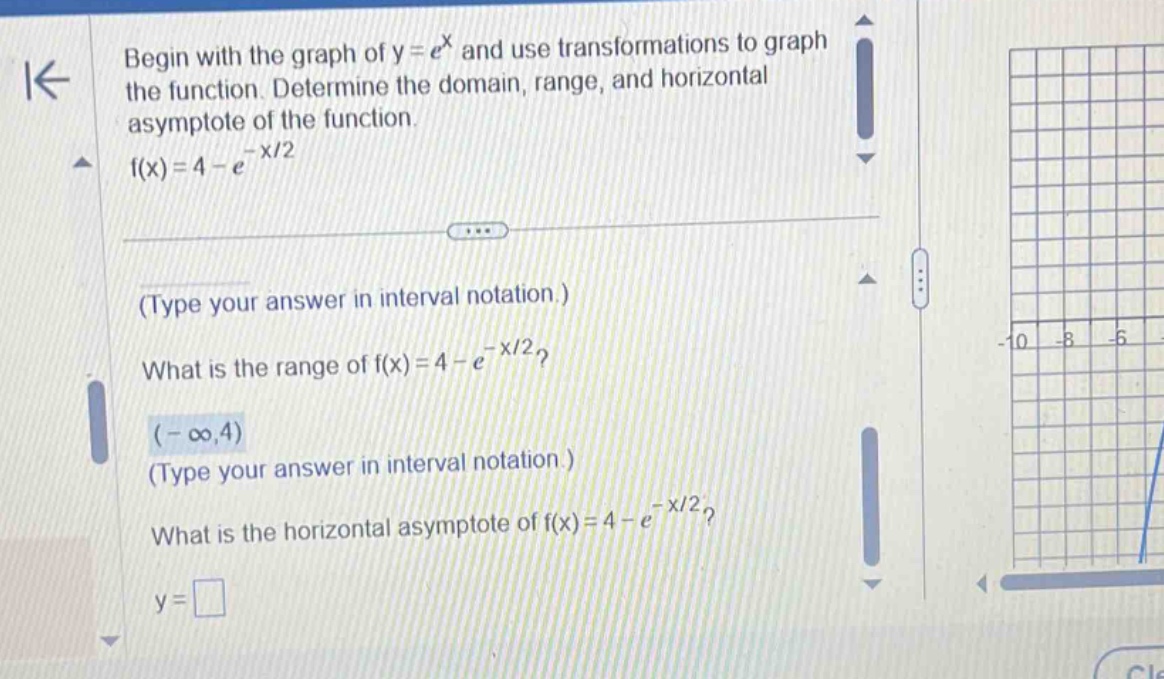
begin with the graph of y = e^x and use transformations to graph the function. determine the domain, range, and horizontal asymptote of the function. f(x)=4 - e^(-x/2) (type your answer in interval notation.) what is the range of f(x)=4 - e^(-x/2)? (-∞,4) (type your answer in interval notation.) what is the horizontal asymptote of f(x)=4 - e^(-x/2)? y = □
Answer
Explanation:
Step1: Analyze the exponential - function properties
The general form of an exponential function is $y = a\cdot b^{cx}+d$. For the function $f(x)=4 - e^{-x/2}$, we know that the domain of an exponential function of the form $y = e^{u}$ (where $u$ is a real - valued function of $x$) is all real numbers. Since $u =-\frac{x}{2}$ is a real - valued function for all real $x$, the domain of $f(x)$ is $(-\infty,\infty)$.
Step2: Analyze the range
We know that the range of the exponential function $y = e^{u}$ is $(0,\infty)$. For the function $y = e^{-x/2}$, the range is $(0,\infty)$. Then, for $y=-e^{-x/2}$, we multiply the values of $e^{-x/2}$ by $- 1$, so the range of $y=-e^{-x/2}$ is $(-\infty,0)$. Finally, for $f(x)=4 - e^{-x/2}$, we shift the graph of $y=-e^{-x/2}$ up by 4 units. So the range of $f(x)$ is $(-\infty,4)$.
Step3: Find the horizontal asymptote
As $x\to\infty$, $u =-\frac{x}{2}\to-\infty$. Then $e^{-x/2}\to0$. So, $\lim_{x\to\infty}(4 - e^{-x/2})=4$. As $x\to-\infty$, $u =-\frac{x}{2}\to\infty$ and $e^{-x/2}\to\infty$, and $4 - e^{-x/2}\to-\infty$. The horizontal asymptote of the function $y = 4 - e^{-x/2}$ is $y = 4$.
Answer:
Domain: $(-\infty,\infty)$ Range: $(-\infty,4)$ Horizontal asymptote: $y = 4$