begin with the graph of y = e^x and use transformations to graph the function. determine the domain, range…
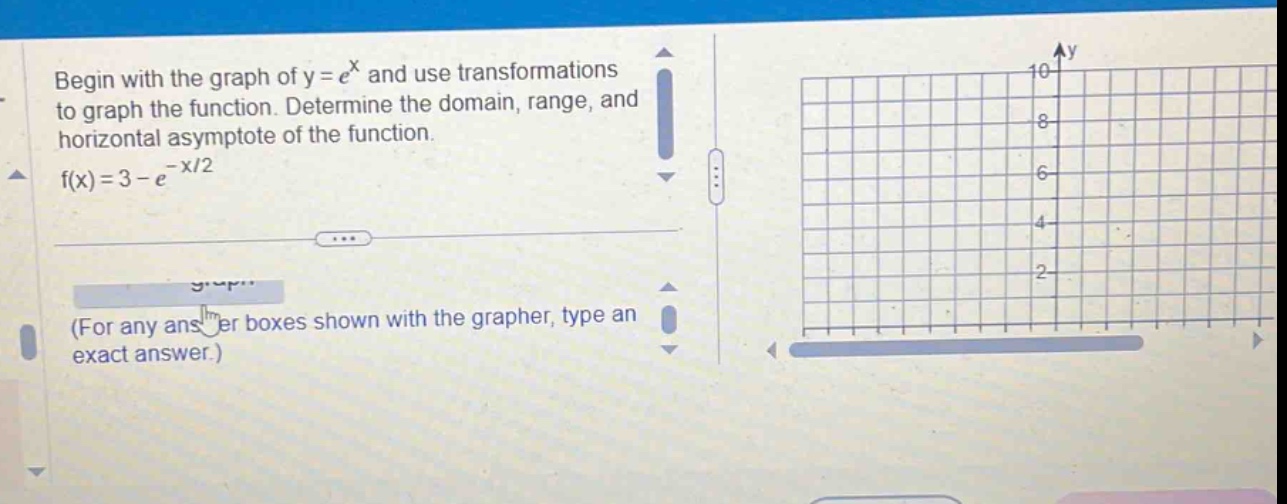
begin with the graph of y = e^x and use transformations to graph the function. determine the domain, range, and horizontal asymptote of the function. f(x)=3 - e^(-x/2) (for any answer boxes shown with the grapher, type an exact answer.)
Answer
Explanation:
Step1: Analyze domain
The function $f(x)=3 - e^{-x/2}$ is an exponential - type function. There are no restrictions on the value of $x$ for which the function is undefined. So, the domain is all real numbers. In interval notation, the domain is $(-\infty,\infty)$.
Step2: Analyze range
We know that the exponential function $y = e^{u}$ has a range of $(0,\infty)$ for any real - valued $u$. Let $u=-\frac{x}{2}$. Then $y = e^{-x/2}$ has a range of $(0,\infty)$. Now, consider $y=-e^{-x/2}$, which has a range of $(-\infty,0)$. Then for $f(x)=3 - e^{-x/2}$, we add 3 to $-e^{-x/2}$. So the range of $f(x)$ is $(-\infty,3)$.
Step3: Analyze horizontal asymptote
As $x\rightarrow\infty$, $u =-\frac{x}{2}\rightarrow-\infty$. Then $e^{-x/2}=e^{u}\rightarrow0$. So, $\lim_{x\rightarrow\infty}(3 - e^{-x/2})=3$. As $x\rightarrow-\infty$, $u =-\frac{x}{2}\rightarrow\infty$, and $e^{-x/2}\rightarrow\infty$, so $3 - e^{-x/2}\rightarrow-\infty$. The horizontal asymptote is $y = 3$.
Answer:
Domain: $(-\infty,\infty)$ Range: $(-\infty,3)$ Horizontal asymptote: $y = 3$