begin by graphing f(x)=ln x. use transformations of this graph to graph the given function. graph and give…
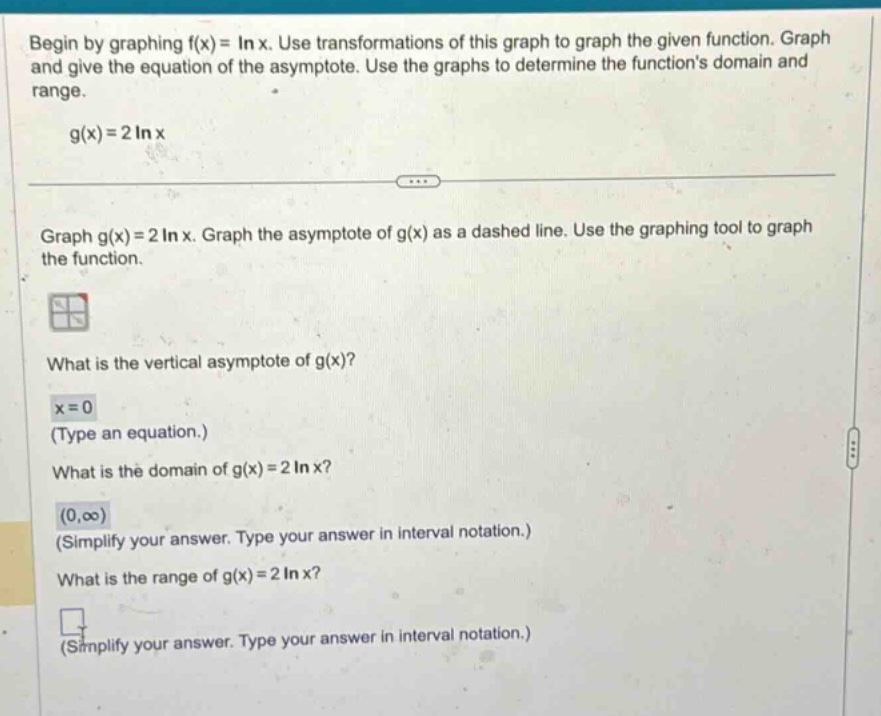
begin by graphing f(x)=ln x. use transformations of this graph to graph the given function. graph and give the equation of the asymptote. use the graphs to determine the functions domain and range. g(x)=2ln x graph g(x)=2ln x. graph the asymptote of g(x) as a dashed line. use the graphing tool to graph the function. what is the vertical asymptote of g(x)? x = 0 (type an equation.) what is the domain of g(x)=2ln x? (0,∞) (simplify your answer. type your answer in interval notation.) what is the range of g(x)=2ln x? (simplify your answer. type your answer in interval notation.)
Answer
Explanation:
Step1: Analyze the transformation
The function $g(x)=2\ln x$ is a vertical stretch of $f(x)=\ln x$ by a factor of 2. The vertical - asymptote of $y = \ln x$ is $x = 0$, and this is not affected by the vertical stretch.
Step2: Determine the domain
The domain of the natural - logarithm function $y=\ln x$ is $(0,\infty)$. Since $g(x)=2\ln x$ is a transformation of $y = \ln x$, the domain remains the set of positive real numbers, $(0,\infty)$.
Step3: Determine the range
The range of $y=\ln x$ is $(-\infty,\infty)$. A vertical stretch by a factor of 2 does not change the range. So the range of $g(x)=2\ln x$ is also $(-\infty,\infty)$.
Answer:
$(-\infty,\infty)$