begin by graphing f(x)=3^x. then use transformations of this graph to graph the given function. be sure to…
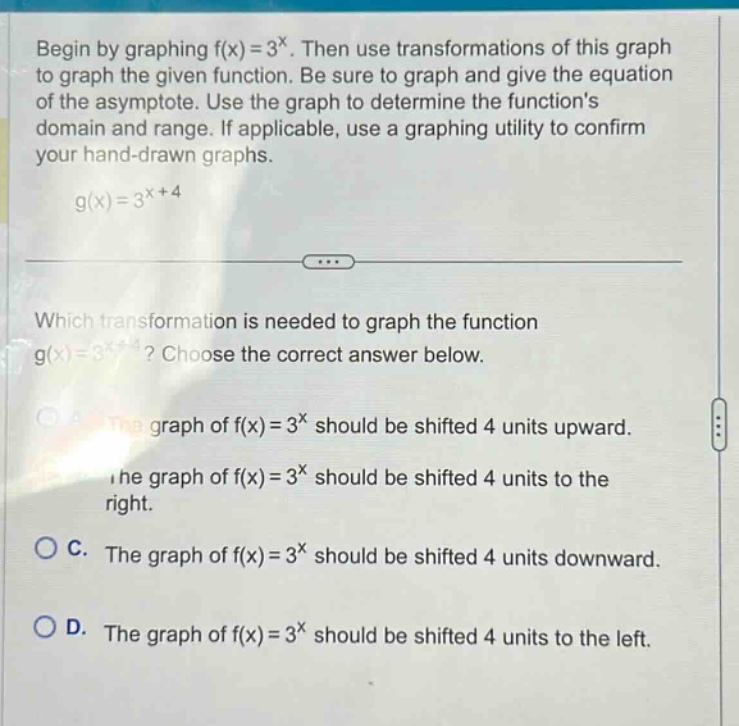
begin by graphing f(x)=3^x. then use transformations of this graph to graph the given function. be sure to graph and give the equation of the asymptote. use the graph to determine the functions domain and range. if applicable, use a graphing utility to confirm your hand - drawn graphs. g(x)=3^(x + 4) which transformation is needed to graph the function g(x)=3^(x + 4)? choose the correct answer below. a. the graph of f(x)=3^x should be shifted 4 units upward. b. the graph of f(x)=3^x should be shifted 4 units to the right. c. the graph of f(x)=3^x should be shifted 4 units downward. d. the graph of f(x)=3^x should be shifted 4 units to the left.
Answer
Explanation:
Step1: Recall transformation rules
For a function $y = f(x + h)$, if $h>0$, the graph of $y = f(x)$ is shifted $h$ units to the left. Here, $f(x)=3^{x}$ and $g(x)=3^{x + 4}$, which is in the form $y = f(x+4)$.
Answer:
D. The graph of $f(x)=3^{x}$ should be shifted 4 units to the left.