beth deposited $6,461.00 into a new savings account that earns interest compounded continuously. after 7…
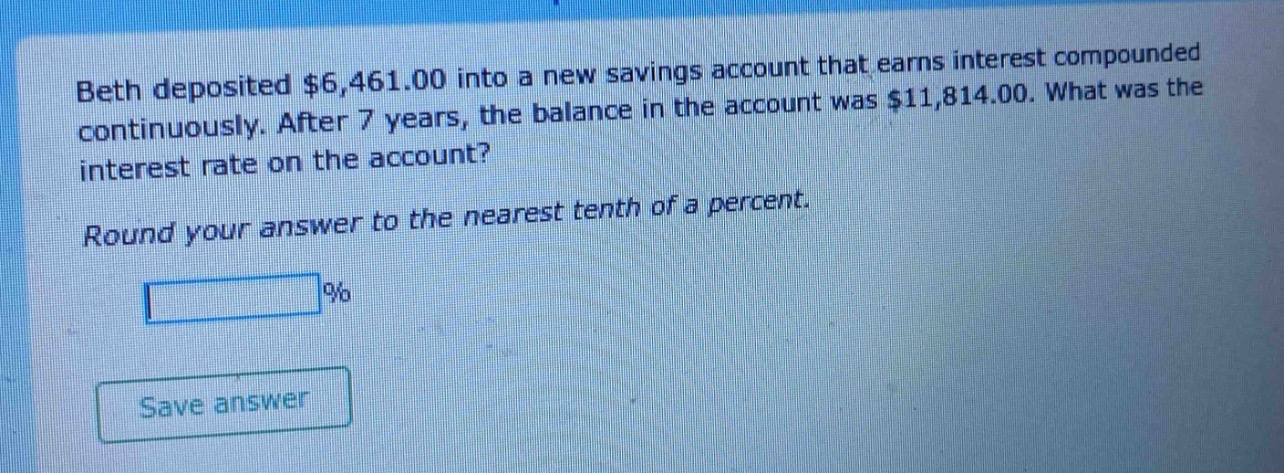
beth deposited $6,461.00 into a new savings account that earns interest compounded continuously. after 7 years, the balance in the account was $11,814.00. what was the interest rate on the account?\nround your answer to the nearest tenth of a percent.\n%
Answer
Explanation:
Step1: Write the continuous - compounding formula
The formula for continuous compounding is (A = Pe^{rt}), where (A) is the final amount, (P) is the principal amount, (r) is the interest rate, and (t) is the time in years. Given (P=$6461), (A = $11814), (t = 7) years. Substitute these values into the formula: (11814=6461e^{7r}).
Step2: Solve for (e^{7r})
Divide both sides of the equation by (6461): (\frac{11814}{6461}=e^{7r}). Calculate (\frac{11814}{6461}\approx1.8285), so (1.8285 = e^{7r}).
Step3: Take the natural logarithm of both sides
Using the property (\ln(e^{x})=x), take the natural logarithm of both sides: (\ln(1.8285)=\ln(e^{7r})). Since (\ln(e^{7r}) = 7r), and (\ln(1.8285)\approx0.603). So (0.603 = 7r).
Step4: Solve for (r)
Divide both sides by (7): (r=\frac{0.603}{7}\approx0.086).
Answer:
(8.6%)