the blades of a windmill turn on an axis that is 35 feet above the ground. the blades are 10 feet long and…
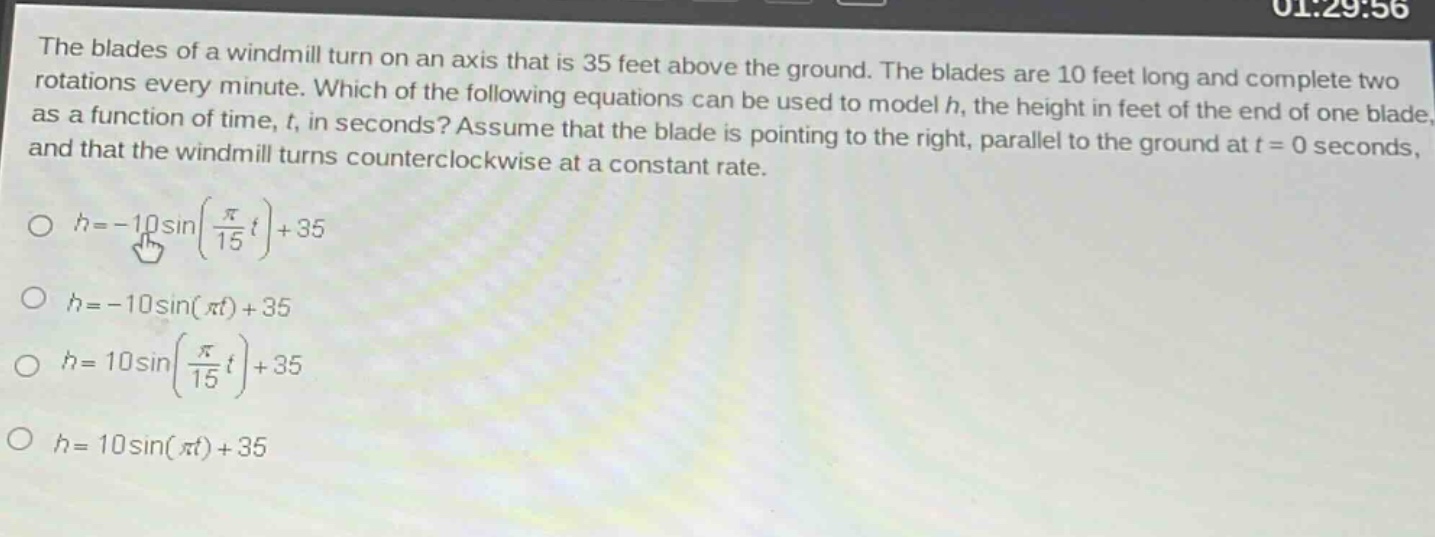
the blades of a windmill turn on an axis that is 35 feet above the ground. the blades are 10 feet long and complete two rotations every minute. which of the following equations can be used to model h, the height in feet of the end of one blade, as a function of time, t, in seconds? assume that the blade is pointing to the right, parallel to the ground at t = 0 seconds, and that the windmill turns counterclockwise at a constant rate.\n○ h=-10sin(\\frac{\\pi}{15}t)+35\n○ h=-10sin(\\pi t)+35\n○ h = 10sin(\\frac{\\pi}{15}t)+35\n○ h = 10sin(\\pi t)+35
Answer
Explanation:
Step1: Find the angular frequency
The wind - mill makes 2 rotations per minute. One rotation is (2\pi) radians. So in one minute (60 seconds), the angle it covers is (2\times2\pi = 4\pi) radians. The angular frequency (\omega=\frac{4\pi}{60}=\frac{\pi}{15}) radians per second.
Step2: Determine the amplitude and vertical shift
The length of the blade is 10 feet, so the amplitude (A = 10). The axis of the wind - mill is 35 feet above the ground, so the vertical shift (D=35).
Step3: Choose the correct sine - function form
At (t = 0), the blade is parallel to the ground. A sine function (y = A\sin(\omega t)+D) is appropriate. Since the blade starts at the mid - height position (parallel to the ground) and moves up and down, and we want the standard sine - wave behavior, the function is (h = 10\sin(\frac{\pi}{15}t)+35).
Answer:
C. (h = 10\sin(\frac{\pi}{15}t)+35)