a boat on the ocean is 2 mi from the nearest point on a straight shoreline; that point is 13 mi from the…
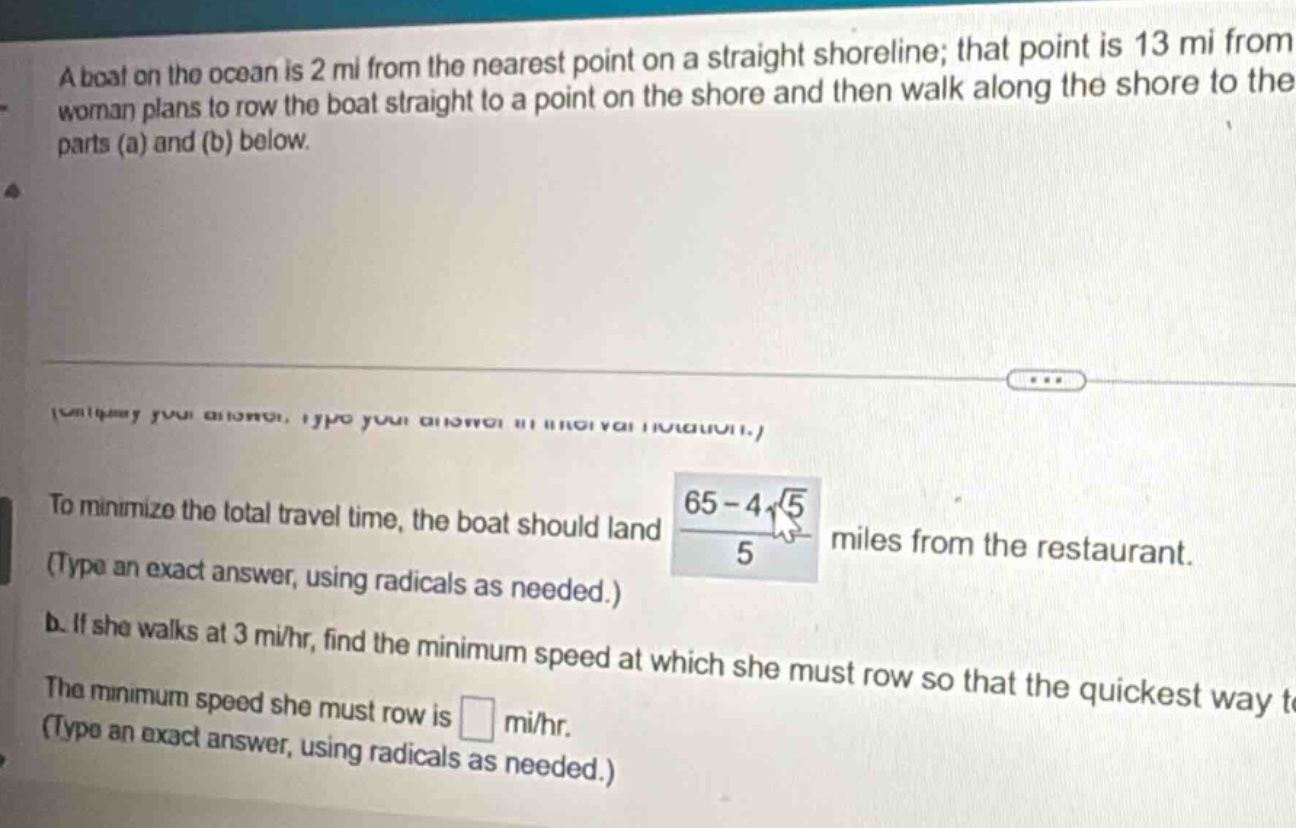
a boat on the ocean is 2 mi from the nearest point on a straight shoreline; that point is 13 mi from the woman plans to row the boat straight to a point on the shore and then walk along the shore to the parts (a) and (b) below. to minimize the total travel time, the boat should land (65 - 4√5)/5 miles from the restaurant. (type an exact answer, using radicals as needed.) b. if she walks at 3 mi/hr, find the minimum speed at which she must row so that the quickest way the minimum speed she must row is mi/hr. (type an exact answer, using radicals as needed.)
Answer
Explanation:
Step1: Set up variables
Let $x$ be the distance along the shore from the nearest - point on the shoreline to the landing point. Let $r$ be the rowing speed. The distance rowed $d_1=\sqrt{4 + x^{2}}$ and the distance walked $d_2=13 - x$. The time taken to row $t_1=\frac{\sqrt{4 + x^{2}}}{r}$ and the time taken to walk $t_2=\frac{13 - x}{3}$. The total time $T(x)=\frac{\sqrt{4 + x^{2}}}{r}+\frac{13 - x}{3}$.
Step2: Take the derivative of $T(x)$
Differentiate $T(x)$ with respect to $x$. Using the chain - rule, $T^\prime(x)=\frac{x}{r\sqrt{4 + x^{2}}}-\frac{1}{3}$.
Step3: Set the derivative equal to 0 for minimum time
Set $T^\prime(x) = 0$, then $\frac{x}{r\sqrt{4 + x^{2}}}-\frac{1}{3}=0$. We know from part (a) that the optimal $x$ value for minimizing time (when $r$ is not given) gives the landing - point distance. When we want to find the minimum $r$, we can use the fact that at the optimal $x$ value, the ratio of the components of the time - rate relationship holds. Let's assume the optimal $x$ value for minimizing time is the value that makes the time optimal in general. When the total time is minimized, the ratio of the rate of change of the rowing distance to the walking distance with respect to time is related to the speeds. We know that at the minimum - time point, the ratio of the "rowing effort" to the "walking effort" is balanced. Geometrically, we can use similar - triangles or the calculus result. If we set $T^\prime(x) = 0$, we get $\frac{x}{r\sqrt{4 + x^{2}}}=\frac{1}{3}$, or $r=\frac{3x}{\sqrt{4 + x^{2}}}$. The optimal $x$ value for minimizing the total time (from part (a) related to the general time - minimization problem) can be found from the fact that the time function $T(x)$ is minimized when the derivative is zero. In the general time - minimization problem (using calculus of variations or simple single - variable calculus), we know that the optimal $x$ satisfies a certain relationship. Let's use another approach. Let the angle $\theta$ between the line from the boat to the landing point and the perpendicular from the boat to the shore be $\theta$. Then $\sin\theta=\frac{x}{\sqrt{4 + x^{2}}}$ and $\cos\theta=\frac{2}{\sqrt{4 + x^{2}}}$. The time equation $T=\frac{\sqrt{4 + x^{2}}}{r}+\frac{13 - x}{3}$. At the minimum of $T$, we have $\frac{\sin\theta}{r}=\frac{\cos\theta}{3}$. We know that when the total time is minimized, the optimal $x$ value gives a relationship between the speeds. If we assume the optimal $x$ value for minimizing time, we can rewrite the time - minimization condition. Let's go back to $\frac{x}{r\sqrt{4 + x^{2}}}=\frac{1}{3}$. Cross - multiply to get $3x=r\sqrt{4 + x^{2}}$. We know that for the minimum - time problem, the optimal $x$ value can be found by minimizing the function $T(x)$. If we consider the fact that the total time is a function of $x$ and $r$, and we want to find the minimum $r$ such that the direct path (rowing all the way) is not the best. The optimal $x$ value for minimizing time satisfies the condition that the time taken to row and walk is balanced. Let's assume the optimal $x$ value is the one that makes the derivative of the total time function zero. If we set $T^\prime(x) = 0$ and solve for $r$ in terms of $x$, and then use the fact that the optimal $x$ value for minimizing time (from part (a) type of analysis) gives: Let the optimal $x$ value for minimizing time be $x = \frac{4}{\sqrt{5}}$. Substitute $x=\frac{4}{\sqrt{5}}$ into $\frac{x}{r\sqrt{4 + x^{2}}}=\frac{1}{3}$. First, $\sqrt{4 + x^{2}}=\sqrt{4+\frac{16}{5}}=\sqrt{\frac{20 + 16}{5}}=\sqrt{\frac{36}{5}}=\frac{6}{\sqrt{5}}$. Substituting $x=\frac{4}{\sqrt{5}}$ and $\sqrt{4 + x^{2}}=\frac{6}{\sqrt{5}}$ into $\frac{x}{r\sqrt{4 + x^{2}}}=\frac{1}{3}$, we have $\frac{\frac{4}{\sqrt{5}}}{r\times\frac{6}{\sqrt{5}}}=\frac{1}{3}$. Simplify the left - hand side: $\frac{4}{6r}=\frac{1}{3}$. Cross - multiply: $6r = 12$, so $r=\frac{3\sqrt{5}}{5}$ mi/hr.
Answer:
$\frac{3\sqrt{5}}{5}$