a boat on the ocean is 4 mi from the nearest point on a straight shoreline; that point is 7 mi from a…
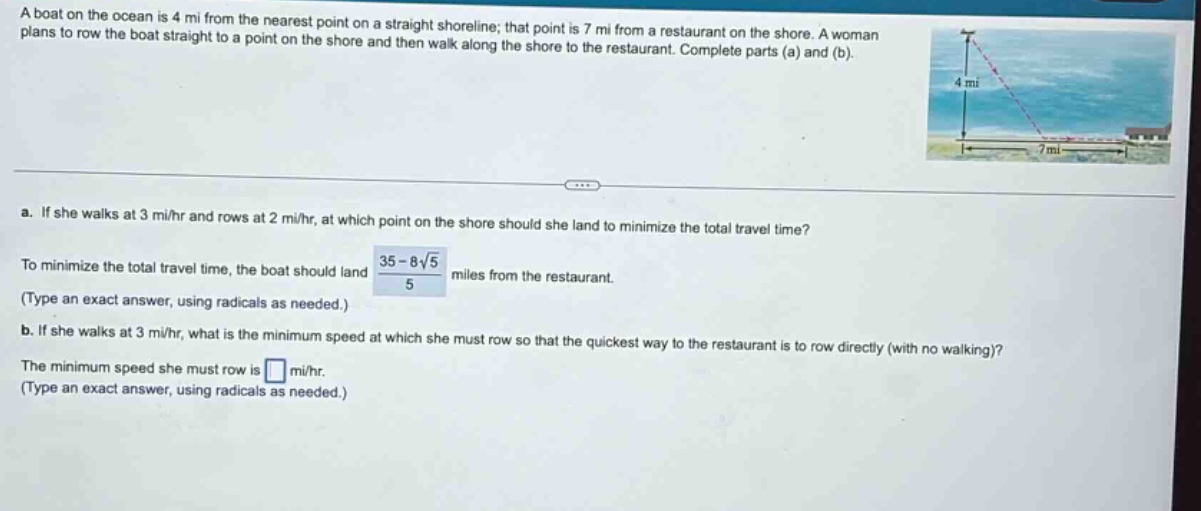
a boat on the ocean is 4 mi from the nearest point on a straight shoreline; that point is 7 mi from a restaurant on the shore. a woman plans to row the boat straight to a point on the shore and then walk along the shore to the restaurant. complete parts (a) and (b). a. if she walks at 3 mi/hr and rows at 2 mi/hr, at which point on the shore should she land to minimize the total travel time? to minimize the total travel time, the boat should land (35 - 8√5)/5 miles from the restaurant. (type an exact answer, using radicals as needed.) b. if she walks at 3 mi/hr, what is the minimum speed at which she must row so that the quickest way to the restaurant is to row directly (with no walking)? the minimum speed she must row is mi/hr. (type an exact answer, using radicals as needed.)
Answer
Explanation:
Step1: Set up variables
Let $x$ be the distance from the point on the shore nearest to the boat to the landing - point. Then the distance rowed $d_1=\sqrt{4^{2}+x^{2}}$ and the distance walked $d_2 = 7 - x$. The time taken to row $t_1=\frac{\sqrt{16 + x^{2}}}{2}$ and the time taken to walk $t_2=\frac{7 - x}{3}$. The total - time function $T(x)=\frac{\sqrt{16 + x^{2}}}{2}+\frac{7 - x}{3}$.
Step2: Differentiate the time function
Differentiate $T(x)$ with respect to $x$. Using the chain - rule, $T^\prime(x)=\frac{x}{2\sqrt{16 + x^{2}}}-\frac{1}{3}$.
Step3: Set the derivative equal to zero
Set $T^\prime(x) = 0$, then $\frac{x}{2\sqrt{16 + x^{2}}}-\frac{1}{3}=0$. Cross - multiply to get $3x = 2\sqrt{16 + x^{2}}$. Square both sides: $9x^{2}=4(16 + x^{2})$. Expand: $9x^{2}=64 + 4x^{2}$. Rearrange: $5x^{2}=64$, so $x=\frac{8}{\sqrt{5}}$. The distance from the restaurant is $7 - x=7-\frac{8}{\sqrt{5}}=\frac{35 - 8\sqrt{5}}{5}$.
Step4: For part (b)
Let the rowing speed be $v$. The distance from the boat to the restaurant is $d=\sqrt{4^{2}+7^{2}}=\sqrt{16 + 49}=\sqrt{65}$. The time to row directly is $t_{row}=\frac{\sqrt{65}}{v}$, and the time to row to the shore and then walk is $t_{walk}=\frac{4}{v}+\frac{7}{3}$. If rowing directly is the quickest way, then $\frac{\sqrt{65}}{v}<\frac{4}{v}+\frac{7}{3}$. Cross - multiply (assuming $v>0$) to get $3\sqrt{65}<12 + 7v$. Rearrange to solve for $v$: $7v>3\sqrt{65}-12$, so $v>\frac{3\sqrt{65}}{7}-\frac{12}{7}$. When the times are equal, we set $\frac{\sqrt{65}}{v}=\frac{4}{v}+\frac{7}{3}$. Cross - multiply: $3\sqrt{65}=12 + 7v$. Solve for $v$: $v=\frac{3\sqrt{65}}{7}$ mi/hr.
Answer:
a. $\frac{35 - 8\sqrt{5}}{5}$ b. $\frac{3\sqrt{65}}{7}$