a boat is pulled into a dock by a rope attached to the bow of the boat and passing through a pulley on the…
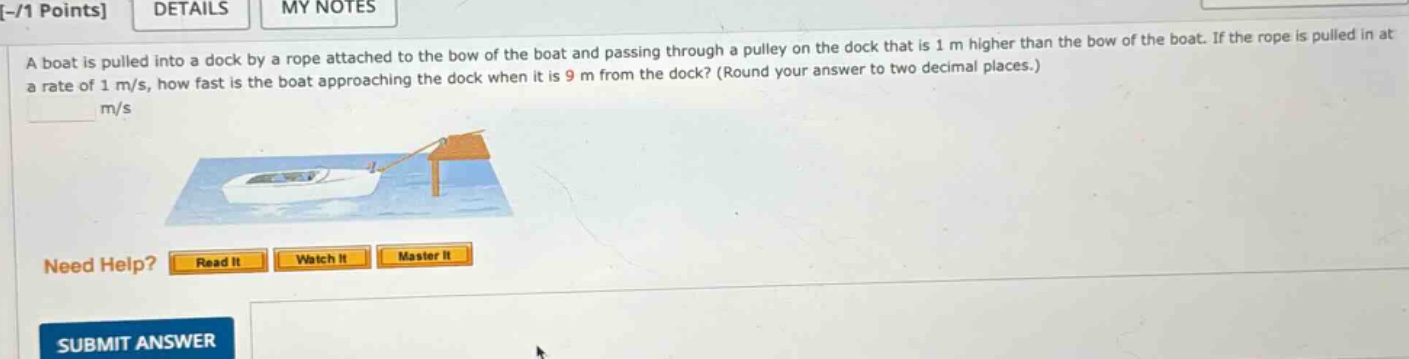
a boat is pulled into a dock by a rope attached to the bow of the boat and passing through a pulley on the dock that is 1 m higher than the bow of the boat. if the rope is pulled in at a rate of 1 m/s, how fast is the boat approaching the dock when it is 9 m from the dock? (round your answer to two decimal places.) m/s need help? read it watch it master it submit answer
Answer
Explanation:
Step1: Establish a relationship
Let the horizontal distance of the boat from the dock be $x$ (in meters) and the length of the rope be $l$ (in meters). By the Pythagorean - theorem, $x^{2}+1^{2}=l^{2}$.
Step2: Differentiate with respect to time $t$
Differentiating both sides of the equation $x^{2}+1 = l^{2}$ with respect to $t$ gives $2x\frac{dx}{dt}=2l\frac{dl}{dt}$. Then $\frac{dx}{dt}=\frac{l}{x}\cdot\frac{dl}{dt}$.
Step3: Find the value of $l$ when $x = 9$
When $x = 9$, using $x^{2}+1^{2}=l^{2}$, we have $l=\sqrt{9^{2}+1^{2}}=\sqrt{81 + 1}=\sqrt{82}$.
Step4: Substitute the known values
We know that $\frac{dl}{dt}=-1$ (negative because the length of the rope $l$ is decreasing). Substituting $x = 9$, $l=\sqrt{82}$, and $\frac{dl}{dt}=-1$ into $\frac{dx}{dt}=\frac{l}{x}\cdot\frac{dl}{dt}$, we get $\frac{dx}{dt}=\frac{\sqrt{82}}{9}\times(-1)\approx - 1.01$.
Answer:
$1.01$