6. a box with an open top is to be constructed from a square piece of cardboard, 3 m wide, by cutting out a…
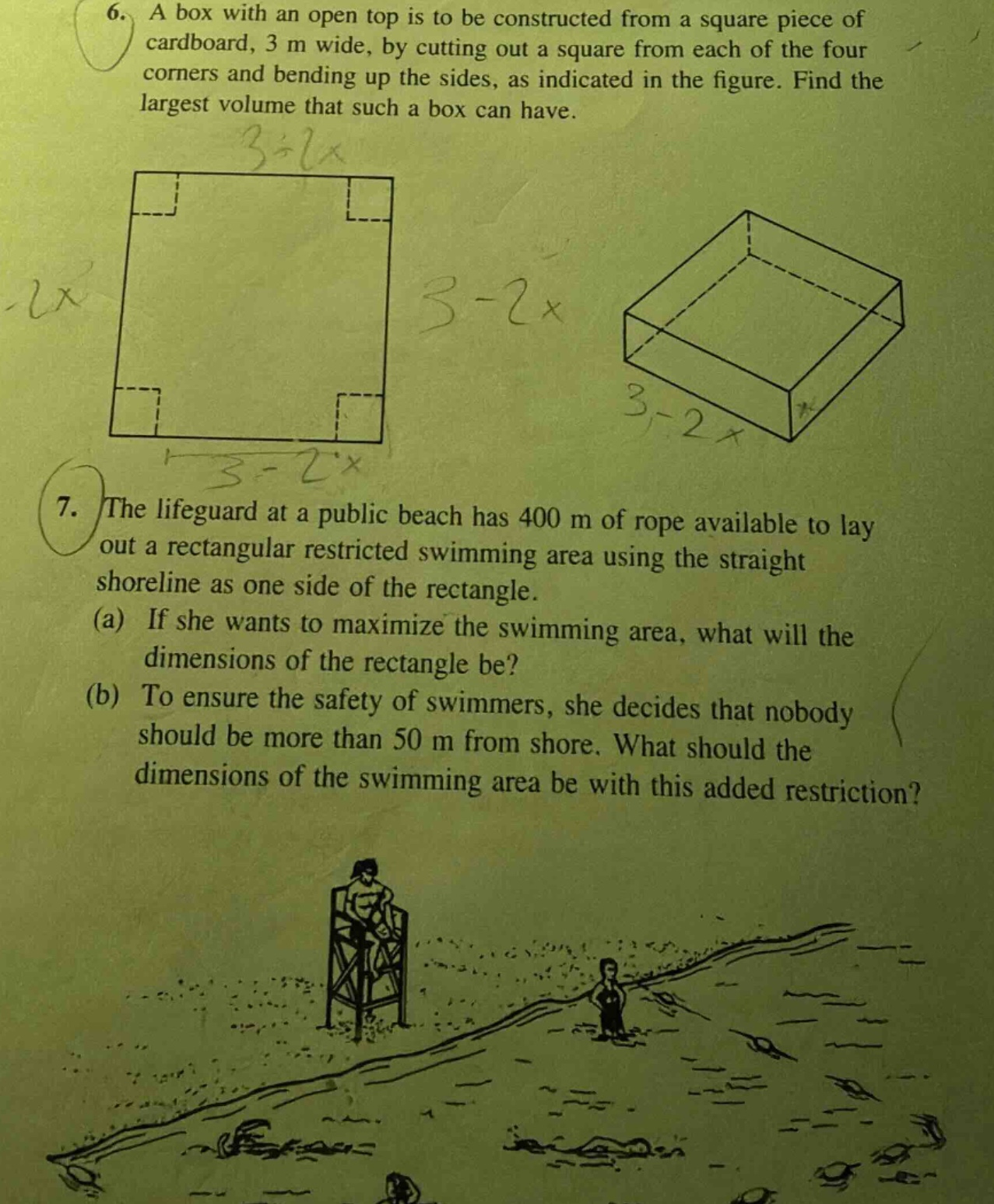
6. a box with an open top is to be constructed from a square piece of cardboard, 3 m wide, by cutting out a square from each of the four corners and bending up the sides, as indicated in the figure. find the largest volume that such a box can have. 7. the lifeguard at a public beach has 400 m of rope available to lay out a rectangular restricted swimming area using the straight shoreline as one side of the rectangle. (a) if she wants to maximize the swimming area, what will the dimensions of the rectangle be? (b) to ensure the safety of swimmers, she decides that nobody should be more than 50 m from shore. what should the dimensions of the swimming area be with this added restriction?
Answer
Explanation:
Step1: Define the volume function for the box
Let the side - length of the square cut from each corner be $x$ meters. The base of the box will be a square with side - length $(3 - 2x)$ meters and the height of the box is $x$ meters. The volume $V$ of the box is given by $V(x)=(3 - 2x)^2x=x(9 - 12x + 4x^2)=4x^3-12x^2 + 9x$, where $0\lt x\lt1.5$ (since $3-2x\gt0$).
Step2: Find the derivative of the volume function
Using the power rule, $V^\prime(x)=12x^2-24x + 9$.
Step3: Set the derivative equal to zero and solve for $x$
$12x^2-24x + 9 = 0$. Divide through by 3: $4x^2-8x + 3 = 0$. Factor the quadratic equation: $(2x - 1)(2x - 3)=0$. So $x=\frac{1}{2}$ or $x=\frac{3}{2}$. But $x=\frac{3}{2}$ is not in the domain $0\lt x\lt1.5$, so we consider $x = \frac{1}{2}$.
Step4: Find the maximum volume
Substitute $x=\frac{1}{2}$ into the volume function: $V(\frac{1}{2})=(3-2\times\frac{1}{2})^2\times\frac{1}{2}=(3 - 1)^2\times\frac{1}{2}=4\times\frac{1}{2}=2$ cubic meters.
Step5: Solve part (a) of the swimming - area problem
Let the length of the side parallel to the shoreline be $x$ meters and the lengths of the two sides perpendicular to the shoreline be $y$ meters. The amount of rope used is $x + 2y=400$, so $x = 400 - 2y$. The area $A$ of the rectangle is $A(y)=(400 - 2y)y=400y-2y^2$.
Step6: Find the derivative of the area function
$A^\prime(y)=400 - 4y$.
Step7: Set the derivative equal to zero and solve for $y$
$400 - 4y=0$, so $y = 100$ meters. Then $x=400-2\times100 = 200$ meters.
Step8: Solve part (b) of the swimming - area problem
Since $y\leq50$, from $x + 2y=400$, we have $x=400 - 2y$. Substitute $y = 50$ into the equation for $x$, then $x=400-2\times50=300$ meters.
Answer:
- The largest volume of the box is $2$ m³.
- (a) The dimensions of the rectangle are $200$ m (parallel to the shoreline) and $100$ m (perpendicular to the shoreline). (b) The dimensions of the rectangle are $300$ m (parallel to the shoreline) and $50$ m (perpendicular to the shoreline).