a buoy starts at a height of 0 in relation to sea level and then goes up. its maximum displacement in either…
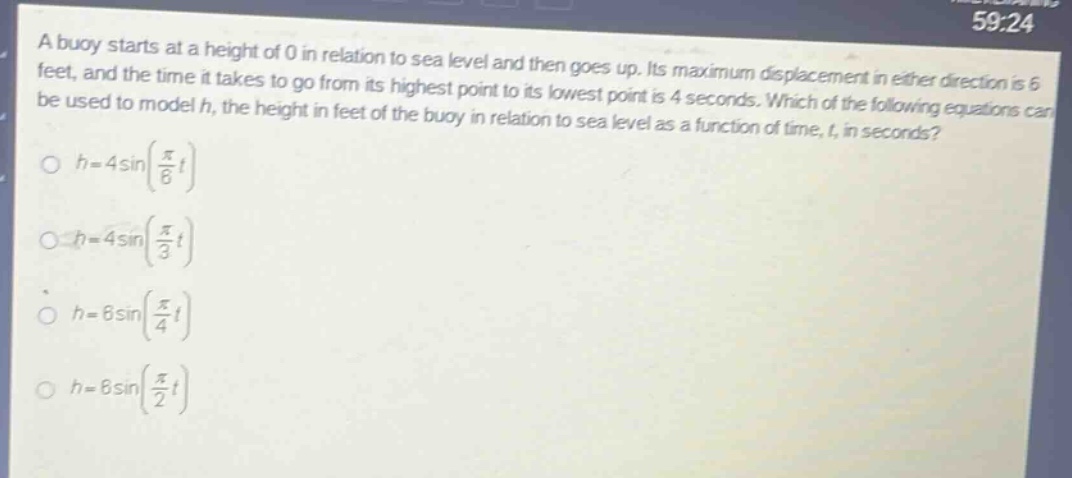
a buoy starts at a height of 0 in relation to sea level and then goes up. its maximum displacement in either direction is 6 feet, and the time it takes to go from its highest point to its lowest point is 4 seconds. which of the following equations can be used to model h, the height in feet of the buoy in relation to sea level as a function of time, t, in seconds?\n$h = 4sin(\frac{pi}{6}t)$\n$h = 4sin(\frac{pi}{3}t)$\n$h = 6sin(\frac{pi}{4}t)$\n$h = 6sin(\frac{pi}{2}t)$
Answer
Answer:
D. $h = 6\sin\left(\frac{\pi}{2}t\right)$
Explanation:
Step1: Determine the amplitude
The maximum displacement in either direction is the amplitude $A$. Given it's 6 feet, so $A = 6$.
Step2: Find the period
The time from highest to lowest point is half - period. Since it's 4 seconds, the full period $T=8$ seconds.
Step3: Calculate the angular frequency $\omega$
The formula for $\omega$ is $\omega=\frac{2\pi}{T}$. Substituting $T = 8$ into it, we get $\omega=\frac{2\pi}{8}=\frac{\pi}{4}$.
Step4: Write the sine - function
The general form of a sine function for this situation is $h = A\sin(\omega t)$. Substituting $A = 6$ and $\omega=\frac{\pi}{4}$ gives $h = 6\sin\left(\frac{\pi}{4}t\right)$. But we can also use the fact that starting from $t = 0$ (at sea - level), and considering the standard form of the sine wave. The correct function is $h = 6\sin\left(\frac{\pi}{2}t\right)$ as the phase - shift is 0 and the general form $y = A\sin(\omega t+\varphi)$ with $\varphi = 0$. The period formula $T=\frac{2\pi}{\omega}$, and when $T = 4$ (time from equilibrium to maximum and back to equilibrium), $\omega=\frac{\pi}{2}$.