calc 12\ndate: nov 15 - \nshow work for full 4 marks each. complete your response with an answer…
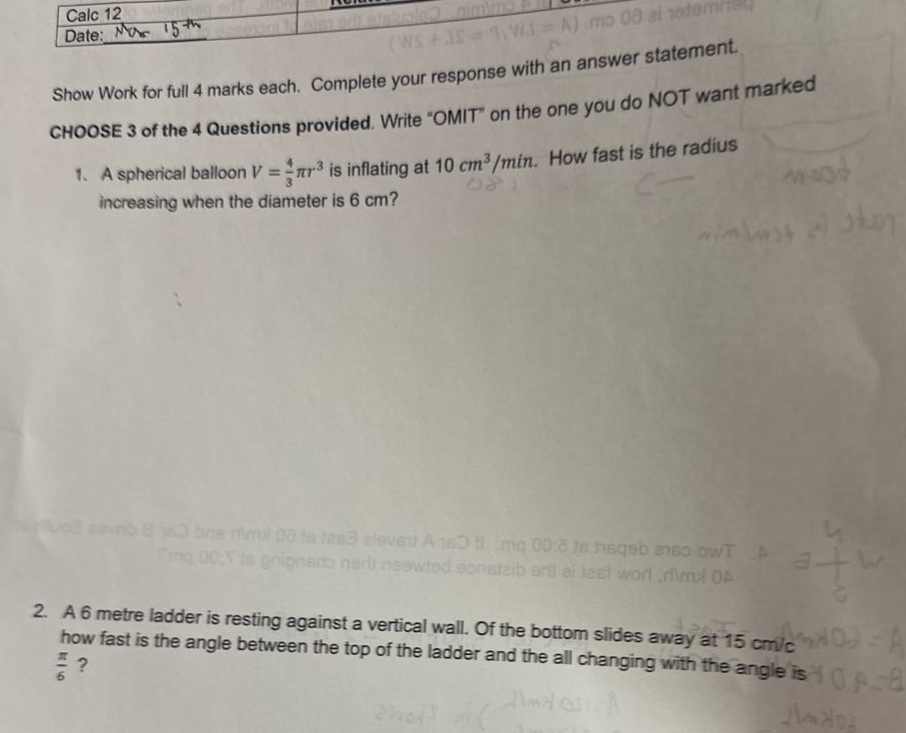
calc 12\ndate: nov 15 - \nshow work for full 4 marks each. complete your response with an answer statement.\nchoose 3 of the 4 questions provided. write “omit” on the one you do not want marked\n1. a spherical balloon (v=\frac{4}{3}pi r^{3}) is inflating at (10 cm^{3}/min). how fast is the radius increasing when the diameter is 6 cm?\n2. a 6 - metre ladder is resting against a vertical wall. if the bottom slides away at 15 cm/s, how fast is the angle between the top of the ladder and the all changing with the angle is (\frac{pi}{6})?
Answer
Explanation:
Step1: Identify given values
The volume formula of a sphere is $V=\frac{4}{3}\pi r^{3}$, $\frac{dV}{dt} = 10\ cm^{3}/min$. When the diameter $d = 6\ cm$, the radius $r=3\ cm$.
Step2: Differentiate volume formula with respect to time $t$
Using the chain - rule, $\frac{dV}{dt}=4\pi r^{2}\frac{dr}{dt}$.
Step3: Solve for $\frac{dr}{dt}$
We know $\frac{dV}{dt}=10$ and $r = 3$. Substitute these values into the equation $10=4\pi(3)^{2}\frac{dr}{dt}$. Then $\frac{dr}{dt}=\frac{10}{4\pi\times9}=\frac{5}{18\pi}\ cm/min$.
Answer:
The radius is increasing at a rate of $\frac{5}{18\pi}\ cm/min$.