calculate ∫(from 1 to 7) (6x + x²) dx, given the following. ∫(from 1 to 7) x² dx = 114 ∫(from 7 to 8) x² dx…
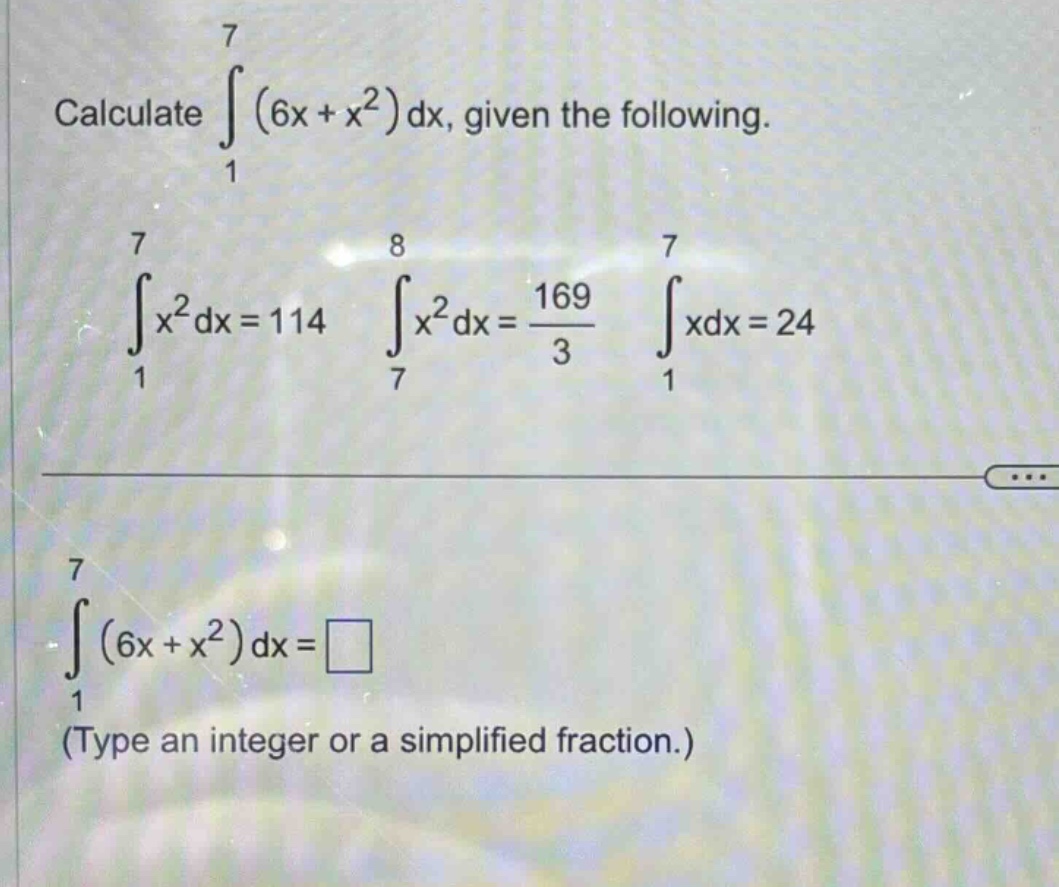
calculate ∫(from 1 to 7) (6x + x²) dx, given the following. ∫(from 1 to 7) x² dx = 114 ∫(from 7 to 8) x² dx = 169/3 ∫(from 1 to 7) xdx = 24 ∫(from 1 to 7) (6x + x²) dx = □ (type an integer or a simplified fraction.)
Answer
Explanation:
Step1: Use integral property
By the property of definite - integrals $\int_{a}^{b}(f(x)+g(x))dx=\int_{a}^{b}f(x)dx+\int_{a}^{b}g(x)dx$, we have $\int_{1}^{7}(6x + x^{2})dx=\int_{1}^{7}6xdx+\int_{1}^{7}x^{2}dx$.
Step2: Use constant - multiple rule of integrals
The constant - multiple rule of integrals states that $\int_{a}^{b}kf(x)dx=k\int_{a}^{b}f(x)dx$. So, $\int_{1}^{7}6xdx = 6\int_{1}^{7}xdx$.
Step3: Substitute given values
We know that $\int_{1}^{7}xdx = 24$ and $\int_{1}^{7}x^{2}dx=114$. Then $6\int_{1}^{7}xdx+\int_{1}^{7}x^{2}dx=6\times24 + 114$.
Step4: Calculate the result
$6\times24+114=144 + 114=258$.
Answer:
$258$