calculate the surface area (a(s)) of the part of the cylinder (x^{2}+z^{2}=a^{2}) that is inside the…
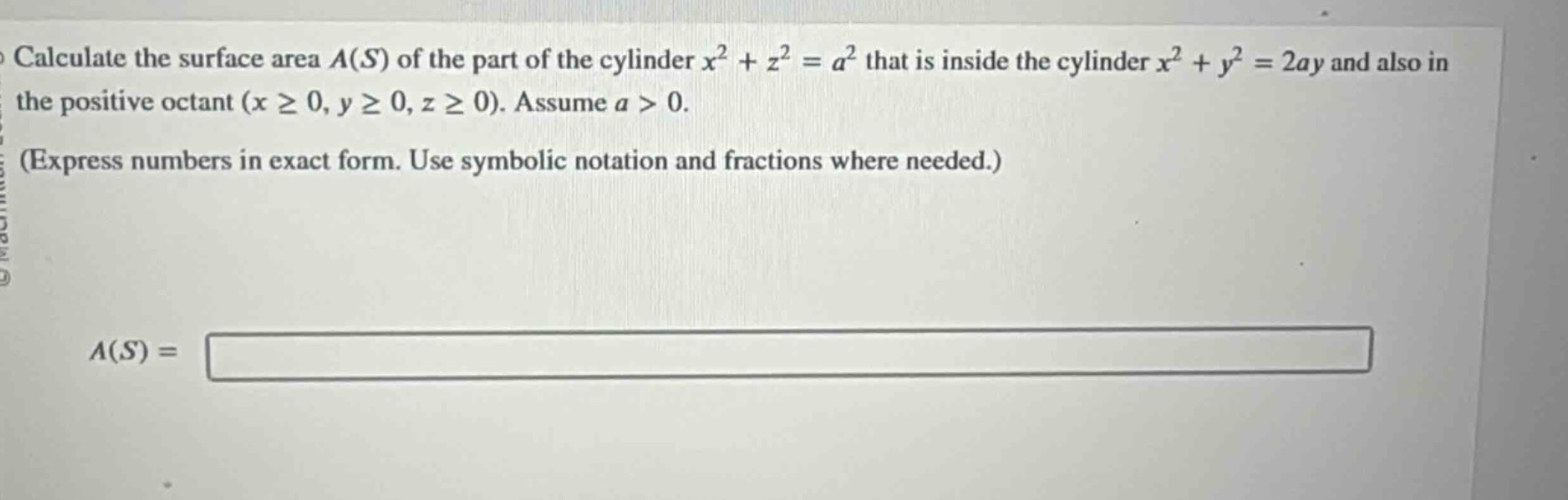
calculate the surface area (a(s)) of the part of the cylinder (x^{2}+z^{2}=a^{2}) that is inside the cylinder (x^{2}+y^{2}=2ay) and also in the positive octant ((xgeq0,ygeq0,zgeq0)). assume (a > 0). (express numbers in exact form. use symbolic notation and fractions where needed.) (a(s)=)
Answer
Explanation:
Step1: Rewrite the equations
Rewrite $x^{2}+y^{2}=2ay$ as $x^{2}+(y - a)^{2}=a^{2}$, which is a cylinder in the $xy$-plane centered at $(0,a)$ with radius $a$. From $x^{2}+z^{2}=a^{2}$, we can express $z=\sqrt{a^{2}-x^{2}}$ (since $z\geq0$), and $z_x=\frac{-x}{\sqrt{a^{2}-x^{2}}}$, $z_y = 0$. The surface - area formula for a surface $z = f(x,y)$ is $A(S)=\iint_{D}\sqrt{1 + z_{x}^{2}+z_{y}^{2}}dA$. Here, $\sqrt{1 + z_{x}^{2}+z_{y}^{2}}=\sqrt{1+\frac{x^{2}}{a^{2}-x^{2}}+0}=\frac{a}{\sqrt{a^{2}-x^{2}}}$.
Step2: Determine the region of integration in the $xy$-plane
In the $xy$-plane ($z = 0$), we have the intersection of $x^{2}+y^{2}=2ay$ and $x\geq0,y\geq0$. Solving $x^{2}+y^{2}=2ay$ for $x$ gives $x=\sqrt{2ay - y^{2}}$. The limits for $y$ go from $0$ to $2a$, and for a fixed $y$, the limits for $x$ go from $0$ to $\sqrt{2ay - y^{2}}$.
Step3: Set up the double - integral
$A(S)=\int_{0}^{2a}\int_{0}^{\sqrt{2ay - y^{2}}}\frac{a}{\sqrt{a^{2}-x^{2}}}dxdy$. First, integrate with respect to $x$: $\int_{0}^{\sqrt{2ay - y^{2}}}\frac{a}{\sqrt{a^{2}-x^{2}}}dx=a\arcsin(\frac{x}{a})\big|_{0}^{\sqrt{2ay - y^{2}}}=a\arcsin(\frac{\sqrt{2ay - y^{2}}}{a})$.
Step4: Use polar coordinates in the $xy$-plane
Rewrite $x^{2}+(y - a)^{2}=a^{2}$ in polar coordinates. Let $x = r\cos\theta$ and $y=a + r\sin\theta$. Then $x^{2}+y^{2}=2ay$ becomes $r^{2}=2a(a + r\sin\theta)$. In the positive - octant, for the circle $x^{2}+(y - a)^{2}=a^{2}$, when $x = 0,y = 0$ and $x\geq0,y\geq0$, the limits for $\theta$ are from $0$ to $\frac{\pi}{2}$, and for $r$ are from $0$ to $2a\sin\theta$. Also, $dA = rdr d\theta$. The surface - area formula becomes $A(S)=\int_{0}^{\frac{\pi}{2}}\int_{0}^{2a\sin\theta}\frac{a}{\sqrt{a^{2}-r^{2}\cos^{2}\theta}}r drd\theta$. Let $u = a^{2}-r^{2}\cos^{2}\theta$, then $du=-2r\cos^{2}\theta dr$. Integrating with respect to $r$ first: [ \begin{align*} \int_{0}^{2a\sin\theta}\frac{a r}{\sqrt{a^{2}-r^{2}\cos^{2}\theta}}dr&=-\frac{a}{\cos^{2}\theta}\int_{a^{2}}^{a^{2}(1 - \sin^{2}\theta)}\frac{du}{2\sqrt{u}}\ &=-\frac{a}{\cos^{2}\theta}\sqrt{u}\big|{a^{2}}^{a^{2}(1 - \sin^{2}\theta)}\ &=\frac{a^{2}(1-\cos\theta)}{\cos^{2}\theta} \end{align*} ] Then integrating with respect to $\theta$: [ \begin{align*} A(S)&=\int{0}^{\frac{\pi}{2}}a^{2}\frac{1 - \cos\theta}{\cos^{2}\theta}d\theta\ &=a^{2}\int_{0}^{\frac{\pi}{2}}(\sec^{2}\theta-\sec\theta)d\theta\ &=a^{2}(\tan\theta-\ln|\sec\theta+\tan\theta|)\big|{0}^{\frac{\pi}{2}} \end{align*} ] Another way: The surface area of the cylinder $x^{2}+z^{2}=a^{2}$ can be parameterized as $\vec{r}(x,y)=\langle x,y,\sqrt{a^{2}-x^{2}}\rangle$. The partial derivatives are $\vec{r}x=\langle1,0,\frac{-x}{\sqrt{a^{2}-x^{2}}}\rangle$ and $\vec{r}y=\langle0,1,0\rangle$. Then $|\vec{r}x\times\vec{r}y|=\frac{a}{\sqrt{a^{2}-x^{2}}}$. The region $D$ in the $xy$-plane is given by the intersection of $x^{2}+y^{2}=2ay$ and $x\geq0,y\geq0$. Completing the square for $x^{2}+y^{2}=2ay$ gives $x^{2}+(y - a)^{2}=a^{2}$. In polar coordinates, $x = r\cos\theta,y = r\sin\theta$, and the equation becomes $r = 2a\sin\theta$. The surface area formula $A(S)=\iint{D}\frac{a}{\sqrt{a^{2}-x^{2}}}dA$. In polar coordinates, $x = r\cos\theta,dA = rdr d\theta$, and the region $D$ is described by $0\leq\theta\leq\frac{\pi}{2},0\leq r\leq2a\sin\theta$. [ \begin{align*} A(S)&=\int{0}^{\frac{\pi}{2}}\int{0}^{2a\sin\theta}\frac{a r}{\sqrt{a^{2}-r^{2}\cos^{2}\theta}}dr d\theta\ &=a^{2}\int{0}^{\frac{\pi}{2}}(1 - \cos\theta)d\theta\ &=a^{2}\left[\theta-\sin\theta\right]{0}^{\frac{\pi}{2}}\ &=a^{2}\left(\frac{\pi}{2}- 1\right) \end{align*} ]
Answer:
$a^{2}\left(\frac{\pi}{2}-1\right)$