calculate the surface area $a(s)$ of the part of the cylinder $x^{2}+z^{2}=a^{2}$ that is inside the…
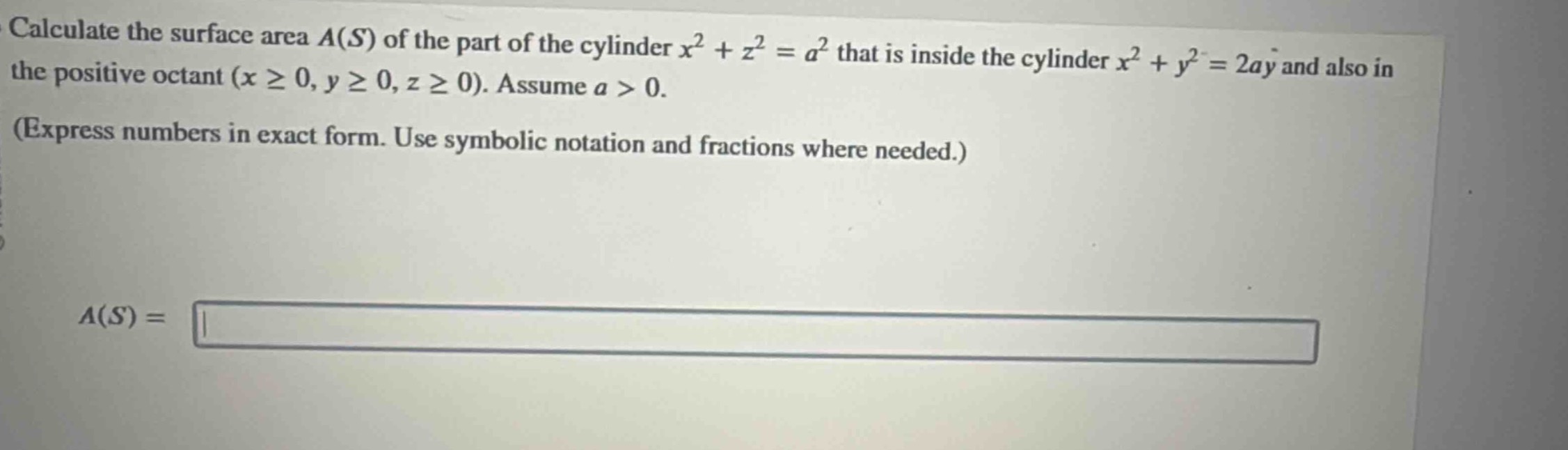
calculate the surface area $a(s)$ of the part of the cylinder $x^{2}+z^{2}=a^{2}$ that is inside the cylinder $x^{2}+y^{2}=2ay$ and also in the positive octant ($xgeq0,ygeq0,zgeq0$). assume $a > 0$. (express numbers in exact form. use symbolic notation and fractions where needed.) $a(s)=$
Answer
Explanation:
Step1: Parametrize the surface
The cylinder $x^{2}+z^{2}=a^{2}$ can be parametrized as $\vec{r}(y,\theta)=a\cos\theta\vec{i}+y\vec{j}+a\sin\theta\vec{k}$, where $x = a\cos\theta$, $y=y$, $z = a\sin\theta$. The partial - derivatives are $\vec{r}{y}=\vec{j}$ and $\vec{r}{\theta}=-a\sin\theta\vec{i}+a\cos\theta\vec{k}$. Then, $\vec{r}{y}\times\vec{r}{\theta}=-a\cos\theta\vec{i}-a\sin\theta\vec{k}$, and $\left|\vec{r}{y}\times\vec{r}{\theta}\right| = a$.
Step2: Find the limits of integration
The cylinder $x^{2}+y^{2}=2ay$ can be rewritten as $x^{2}+(y - a)^{2}=a^{2}$. In the positive octant ($x\geq0,y\geq0,z\geq0$), for the intersection of the two cylinders, from $x^{2}+z^{2}=a^{2}$ and $x^{2}+y^{2}=2ay$. When $z = 0$, $x=a$, and from $x^{2}+y^{2}=2ay$, we have $a^{2}+y^{2}=2ay$, or $(y - a)^{2}=0$, $y=a$. Also, since $x=a\cos\theta\geq0$ and $z=a\sin\theta\geq0$, $0\leq\theta\leq\frac{\pi}{2}$, and from $x^{2}+y^{2}=2ay$ and $x=a\cos\theta$, we get $a^{2}\cos^{2}\theta+y^{2}=2ay$, solving for $y$ gives $y=a - a\sin\theta$ to $y=a + a\sin\theta$. But in the positive - octant and considering the intersection, the limits for $y$ are from $0$ to $2a\sin\theta$.
Step3: Calculate the surface - area integral
The surface - area formula is $A(S)=\iint_{D}\left|\vec{r}{y}\times\vec{r}{\theta}\right|dA$. Substituting $\left|\vec{r}{y}\times\vec{r}{\theta}\right| = a$ and the limits of integration, we have $A(S)=\int_{0}^{\frac{\pi}{2}}\int_{0}^{2a\sin\theta}a;dyd\theta$. First, integrate with respect to $y$: $\int_{0}^{\frac{\pi}{2}}a\left[y\right]{0}^{2a\sin\theta}d\theta=\int{0}^{\frac{\pi}{2}}2a^{2}\sin\theta;d\theta$. Then, integrate with respect to $\theta$: $2a^{2}[-\cos\theta]_{0}^{\frac{\pi}{2}}$.
Step4: Evaluate the definite integral
$2a^{2}[-\cos\theta]_{0}^{\frac{\pi}{2}}=2a^{2}(0 + 1)=2a^{2}$.
Answer:
$2a^{2}$