calculate the taylor polynomials p2(x) and p3(x) centered at a = 0 for f(x)=e^(-x)+e^(-2x). p2(x) must be of…
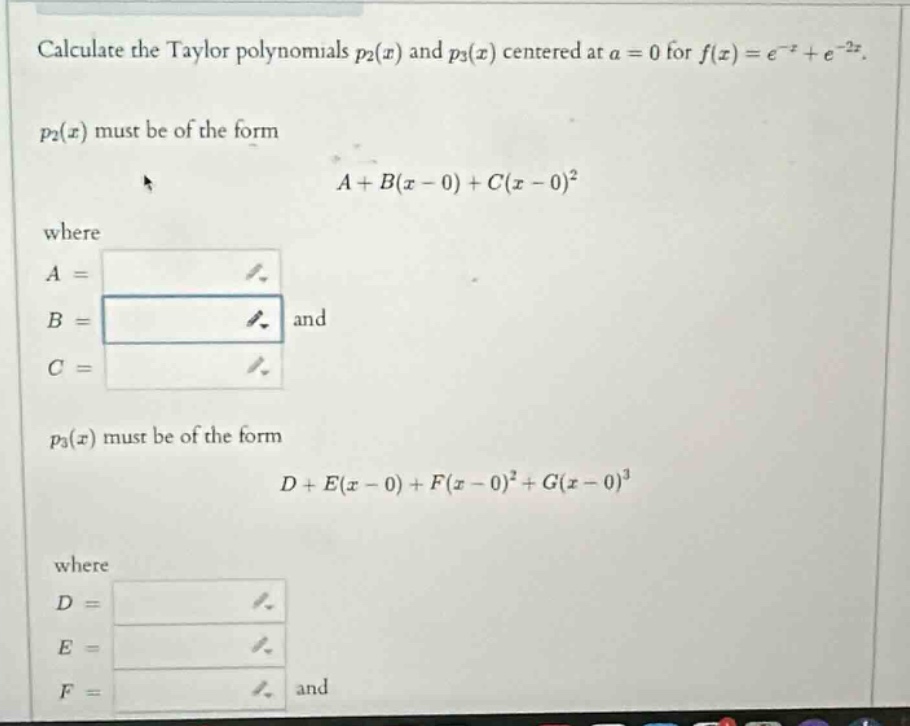
calculate the taylor polynomials p2(x) and p3(x) centered at a = 0 for f(x)=e^(-x)+e^(-2x). p2(x) must be of the form a + b(x - 0)+c(x - 0)^2 where a = b = and c = p3(x) must be of the form d + e(x - 0)+f(x - 0)^2+g(x - 0)^3 where d = e = f = and
Answer
Explanation:
Step1: Recall Taylor - series formula
The Taylor series of a function $f(x)$ centered at $a$ is given by $f(x)=\sum_{n = 0}^{\infty}\frac{f^{(n)}(a)}{n!}(x - a)^n$, where $f^{(n)}(a)$ is the $n$-th derivative of $f(x)$ evaluated at $x = a$. When $a = 0$, it is a Maclaurin series: $f(x)=\sum_{n=0}^{\infty}\frac{f^{(n)}(0)}{n!}x^n$.
Step2: Find the function value at $x = 0$
First, find $f(0)$ for $f(x)=e^{-x}+e^{-2x}$. Substitute $x = 0$ into $f(x)$: $f(0)=e^{-0}+e^{-2\times0}=1 + 1=2$. So for $p_2(x)=A + B(x - 0)+C(x - 0)^2$ and $p_3(x)=D + E(x - 0)+F(x - 0)^2+G(x - 0)^3$, $A = D=f(0)=2$.
Step3: Find the first - derivative
Differentiate $f(x)=e^{-x}+e^{-2x}$ using the chain - rule. $f^\prime(x)=-e^{-x}-2e^{-2x}$. Evaluate at $x = 0$: $f^\prime(0)=-e^{-0}-2e^{-2\times0}=-1-2=-3$. So $B = E=f^\prime(0)=-3$.
Step4: Find the second - derivative
Differentiate $f^\prime(x)=-e^{-x}-2e^{-2x}$ to get $f^{\prime\prime}(x)=e^{-x}+4e^{-2x}$. Evaluate at $x = 0$: $f^{\prime\prime}(0)=e^{-0}+4e^{-2\times0}=1 + 4 = 5$. So $C=F=\frac{f^{\prime\prime}(0)}{2!}=\frac{5}{2}$.
Step5: Find the third - derivative
Differentiate $f^{\prime\prime}(x)=e^{-x}+4e^{-2x}$ to get $f^{(3)}(x)=-e^{-x}-8e^{-2x}$. Evaluate at $x = 0$: $f^{(3)}(0)=-e^{-0}-8e^{-2\times0}=-1-8=-9$. So $G=\frac{f^{(3)}(0)}{3!}=\frac{-9}{6}=-\frac{3}{2}$.
Answer:
$A = 2$ $B=-3$ $C=\frac{5}{2}$ $D = 2$ $E=-3$ $F=\frac{5}{2}$