8. calculator active. mr. sullivan is tired of not having air - conditioning in germany, so he buys a large…
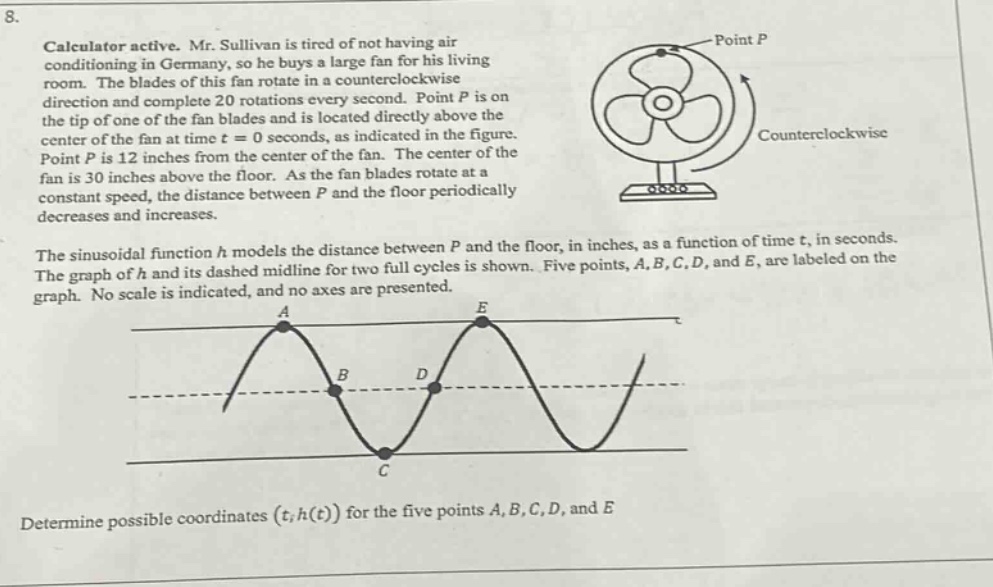
8. calculator active. mr. sullivan is tired of not having air - conditioning in germany, so he buys a large fan for his living room. the blades of this fan rotate in a counterclockwise direction and complete 20 rotations every second. point p is on the tip of one of the fan blades and is located directly above the center of the fan at time t = 0 seconds, as indicated in the figure. point p is 12 inches from the center of the fan. the center of the fan is 30 inches above the floor. as the fan blades rotate at a constant speed, the distance between p and the floor periodically decreases and increases. the sinusoidal function h models the distance between p and the floor, in inches, as a function of time t, in seconds. the graph of h and its dashed midline for two full cycles is shown. five points, a, b, c, d, and e, are labeled on the graph. no scale is indicated, and no axes are presented. determine possible coordinates (t, h(t)) for the five points a, b, c, d, and e.
Answer
Explanation:
Step1: Find the period
The fan completes 20 rotations every second. The period $T$ of one - rotation is $\frac{1}{20}$ seconds.
Step2: Analyze point A
Point A is at a maximum. Since the function is periodic and we can assume the function starts at a maximum (at $t = 0$), for a sinusoidal function $y = A\sin(\omega t+\varphi)+k$ or $y = A\cos(\omega t+\varphi)+k$, if we assume a cosine - type function $h(t)=A\cos(\omega t)+k$. The angular frequency $\omega=\frac{2\pi}{T}=40\pi$. At the first maximum, $t = 0$. The distance from the center of the fan to the floor is 30 inches and the radius of the fan is 12 inches, so the maximum value of $h(t)$ is $30 + 12=42$ inches. So the coordinate of A is $(0,42)$.
Step3: Analyze point B
Point B is on the mid - line. The mid - line value of $h(t)$ is 30 inches. The cosine function $y = A\cos(\omega t)+k$ passes through the mid - line when $\omega t=\frac{\pi}{2}$. Since $\omega = 40\pi$, then $40\pi t=\frac{\pi}{2}$, so $t=\frac{1}{80}$ seconds. The coordinate of B is $(\frac{1}{80},30)$.
Step4: Analyze point C
Point C is at a minimum. The minimum value of $h(t)$ is $30 - 12 = 18$ inches. The cosine function $y = A\cos(\omega t)+k$ reaches a minimum when $\omega t=\pi$. Since $\omega = 40\pi$, then $40\pi t=\pi$, so $t=\frac{1}{40}$ seconds. The coordinate of C is $(\frac{1}{40},18)$.
Step5: Analyze point D
Point D is on the mid - line again. The cosine function $y = A\cos(\omega t)+k$ passes through the mid - line for the second time when $\omega t=\frac{3\pi}{2}$. Since $\omega = 40\pi$, then $40\pi t=\frac{3\pi}{2}$, so $t=\frac{3}{80}$ seconds. The coordinate of D is $(\frac{3}{80},30)$.
Step6: Analyze point E
Point E is at the next maximum. The cosine function $y = A\cos(\omega t)+k$ reaches the next maximum when $\omega t = 2\pi$. Since $\omega=40\pi$, then $40\pi t = 2\pi$, so $t=\frac{1}{20}$ seconds. The coordinate of E is $(\frac{1}{20},42)$.
Answer:
A. $(0,42)$ B. $(\frac{1}{80},30)$ C. $(\frac{1}{40},18)$ D. $(\frac{3}{80},30)$ E. $(\frac{1}{20},42)$