a calculator is allowed on this question. assume that the taylor polynomial of degree three centered at 1 is…
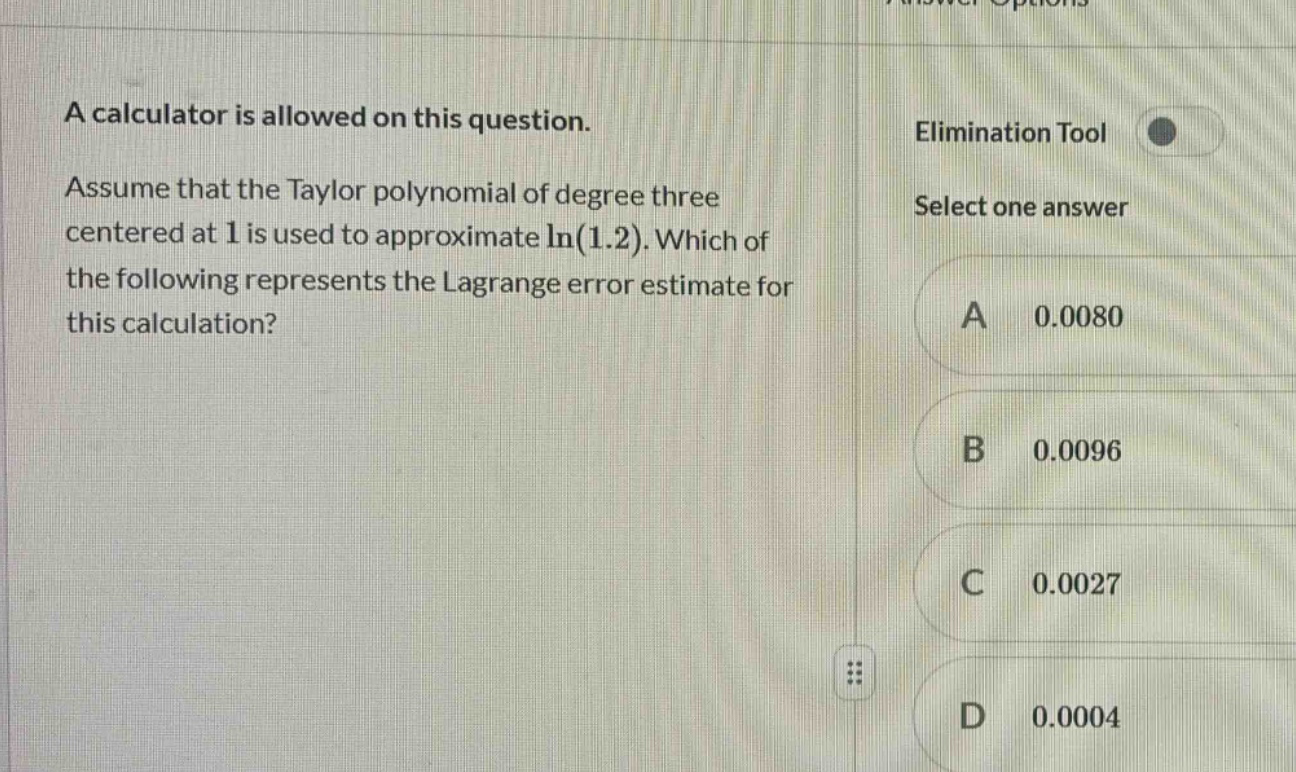
a calculator is allowed on this question. assume that the taylor polynomial of degree three centered at 1 is used to approximate ln(1.2). which of the following represents the lagrange error estimate for this calculation? elimination tool select one answer a 0.0080 b 0.0096 c 0.0027 d 0.0004
Answer
Explanation:
Step1: Recall Lagrange error - formula
The Lagrange error formula for the Taylor polynomial (P_n(x)) of (f(x)) centered at (a) is (R_n(x)=\frac{f^{(n + 1)}(c)}{(n+1)!}(x - a)^{n+1}), where (c) is some number between (a) and (x). For (y = f(x)=\ln(x)), (a = 1), (x=1.2), and (n = 3). First, find the fourth - derivative of (y=\ln(x)). The first - derivative (y'=\frac{1}{x}=x^{-1}), the second - derivative (y''=-x^{-2}), the third - derivative (y''' = 2x^{-3}), and the fourth - derivative (y^{(4)}=-6x^{-4}=-\frac{6}{x^{4}}).
Step2: Determine the bound of (|f^{(4)}(c)|)
Since (c) is between (a = 1) and (x = 1.2), the function (y =|f^{(4)}(x)|=\frac{6}{x^{4}}) is a decreasing function on the interval ([1,1.2]). So, the maximum value of (|f^{(4)}(c)|) on the interval ([1,1.2]) occurs at (x = 1), and (|f^{(4)}(c)|\leq|f^{(4)}(1)| = 6).
Step3: Calculate the error
Using the Lagrange error formula (R_3(x)=\frac{f^{(4)}(c)}{4!}(x - 1)^{4}), with (x = 1.2), (a = 1), and (|f^{(4)}(c)|\leq6). [ \begin{align*} |R_3(1.2)|&\leq\frac{6}{4!}(1.2 - 1)^{4}\ &=\frac{6}{24}(0.2)^{4}\ &=\frac{6}{24}\times0.0016\ &=0.0004 \end{align*} ]
Answer:
D. 0.0004