if a certain cannon is fired from a height of 9.2 meters above the ground, at a certain angle, the height of…
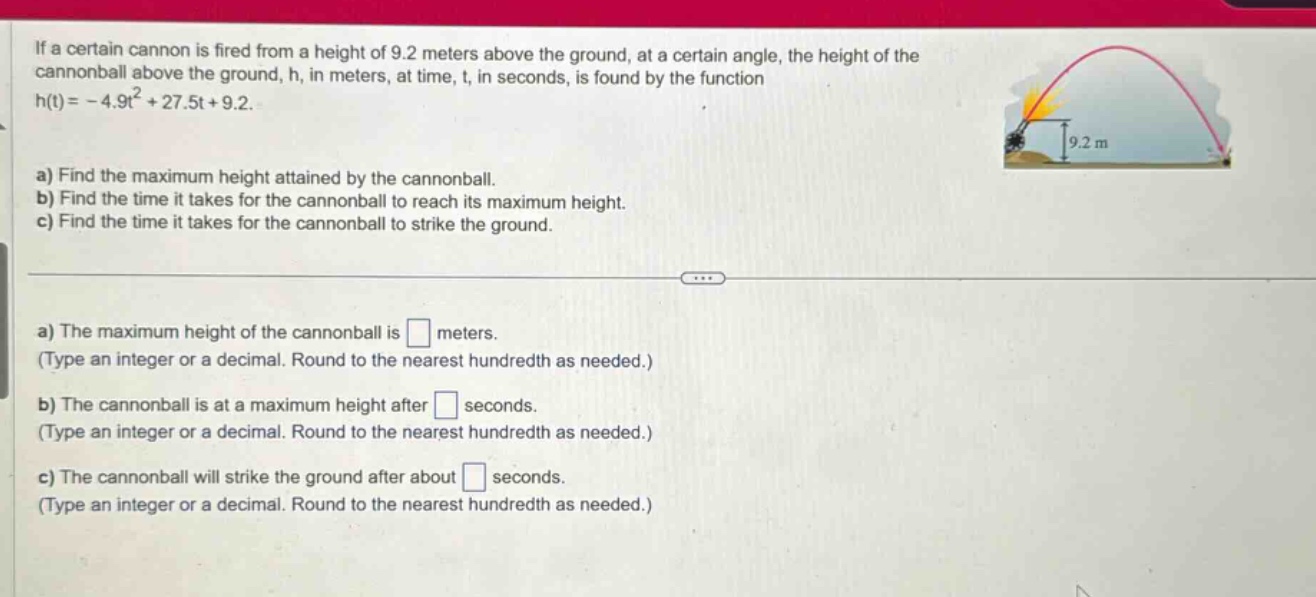
if a certain cannon is fired from a height of 9.2 meters above the ground, at a certain angle, the height of the cannonball above the ground, h, in meters, at time, t, in seconds, is found by the function h(t)= - 4.9t² + 27.5t + 9.2. a) find the maximum height attained by the cannonball. b) find the time it takes for the cannonball to reach its maximum height. c) find the time it takes for the cannonball to strike the ground. a) the maximum height of the cannonball is meters. (type an integer or a decimal. round to the nearest hundredth as needed.) b) the cannonball is at a maximum height after seconds. (type an integer or a decimal. round to the nearest hundredth as needed.) c) the cannonball will strike the ground after about seconds. (type an integer or a decimal. round to the nearest hundredth as needed.)
Answer
Explanation:
Step1: Identify the coefficients
The height - time function is $h(t)=-4.9t^{2}+27.5t + 9.2$, where $a=-4.9$, $b = 27.5$, $c = 9.2$.
Step2: Find the time for maximum height
The time $t$ at which the cannon - ball reaches its maximum height is given by the formula $t=-\frac{b}{2a}$. $t=-\frac{27.5}{2\times(-4.9)}=\frac{27.5}{9.8}\approx2.81$ seconds.
Step3: Find the maximum height
Substitute $t = \frac{27.5}{9.8}$ into the height function $h(t)$. $h(\frac{27.5}{9.8})=-4.9\times(\frac{27.5}{9.8})^{2}+27.5\times\frac{27.5}{9.8}+9.2$ $=-4.9\times\frac{756.25}{96.04}+\frac{756.25}{9.8}+9.2$ $=-\frac{3695.625}{96.04}+\frac{756.25}{9.8}+9.2$ $\approx - 38.48+77.17+9.2$ $\approx47.89$ meters.
Step4: Find the time when the cannon - ball strikes the ground
Set $h(t)=0$, so $-4.9t^{2}+27.5t + 9.2 = 0$. Using the quadratic formula $t=\frac{-b\pm\sqrt{b^{2}-4ac}}{2a}$, where $a=-4.9$, $b = 27.5$, $c = 9.2$. First, calculate the discriminant $\Delta=b^{2}-4ac=(27.5)^{2}-4\times(-4.9)\times9.2=756.25 + 180.32=936.57$. Then $t=\frac{-27.5\pm\sqrt{936.57}}{2\times(-4.9)}=\frac{-27.5\pm30.6}{-9.8}$. We get two solutions for $t$: $t_1=\frac{-27.5 + 30.6}{-9.8}=\frac{3.1}{-9.8}\approx - 0.32$ (rejected since time cannot be negative) $t_2=\frac{-27.5-30.6}{-9.8}=\frac{-58.1}{-9.8}\approx5.93$ seconds.
Answer:
a) $47.89$ b) $2.81$ c) $5.93$