chapter 16 answering free - response questions sample question 1 a graphing calculator is required to answer…
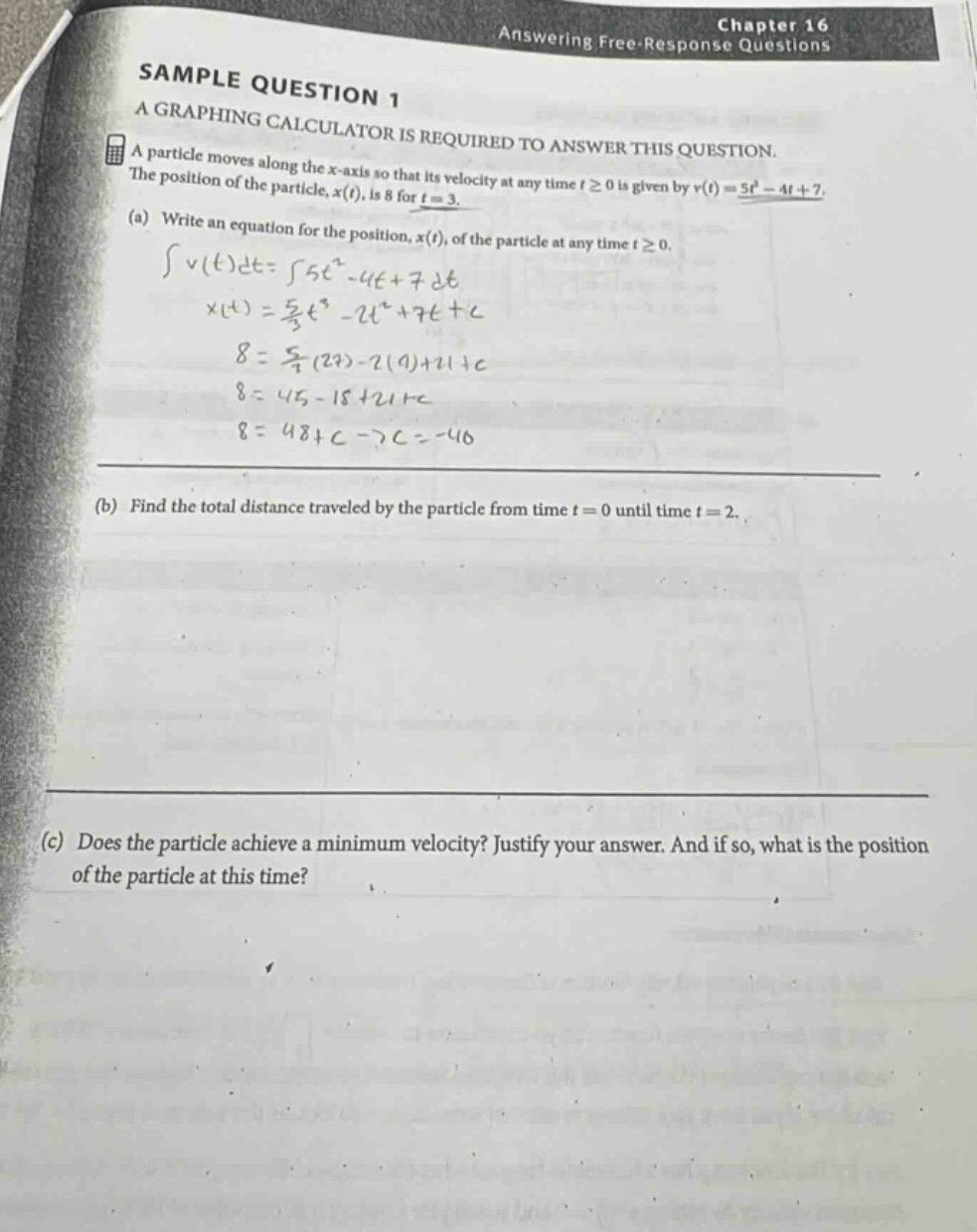
chapter 16 answering free - response questions sample question 1 a graphing calculator is required to answer this question. a particle moves along the x - axis so that its velocity at any time t≥0 is given by v(t)=5t² - 4t + 7. the position of the particle, x(t), is 8 for t = 3. (a) write an equation for the position, x(t), of the particle at any time t≥0. ∫v(t)dt=∫5t² - 4t + 7dt x(t)=5/3t³ - 2t²+7t + c 8 = 5/3(27)-2(9)+21 + c 8 = 45 - 18+21 + c 8 = 48 + c→c=-40 (b) find the total distance traveled by the particle from time t = 0 until time t = 2. (c) does the particle achieve a minimum velocity? justify your answer. and if so, what is the position of the particle at this time?
Answer
Explanation:
Step1: Find position - function for part (a)
Integrate velocity function. [x(t)=\int(5t^{2}-4t + 7)dt=\frac{5}{3}t^{3}-2t^{2}+7t + C] Use (x(3)=8) to find (C). [8=\frac{5}{3}(3)^{3}-2(3)^{2}+7(3)+C] [8 = 45-18 + 21+C] [8=48 + C\Rightarrow C=-40] So (x(t)=\frac{5}{3}t^{3}-2t^{2}+7t-40)
Step2: Find total - distance for part (b)
The total distance (d) is given by (d=\int_{0}^{2}|v(t)|dt). First, find where (v(t)=5t^{2}-4t + 7) is non - negative. The discriminant of the quadratic function (y = 5t^{2}-4t + 7) is (\Delta=b^{2}-4ac=(-4)^{2}-4\times5\times7=16 - 140=- 124<0) and the leading coefficient (a = 5>0), so (v(t)>0) for all (t\geq0). Then (d=\int_{0}^{2}(5t^{2}-4t + 7)dt). [d=\left[\frac{5}{3}t^{3}-2t^{2}+7t\right]_{0}^{2}] [d=\frac{5}{3}(2)^{3}-2(2)^{2}+7(2)] [d=\frac{40}{3}-8 + 14] [d=\frac{40}{3}+6=\frac{40 + 18}{3}=\frac{58}{3}]
Step3: Find minimum velocity for part (c)
Differentiate (v(t)) to find its critical points. (v(t)=5t^{2}-4t + 7), then (v^\prime(t)=10t-4). Set (v^\prime(t)=0), we get (10t-4 = 0\Rightarrow t=\frac{2}{5}). The second - derivative (v^{\prime\prime}(t)=10>0), so (v(t)) has a minimum at (t = \frac{2}{5}). Substitute (t=\frac{2}{5}) into (x(t)): [x\left(\frac{2}{5}\right)=\frac{5}{3}\left(\frac{2}{5}\right)^{3}-2\left(\frac{2}{5}\right)^{2}+7\left(\frac{2}{5}\right)-40] [x\left(\frac{2}{5}\right)=\frac{5}{3}\times\frac{8}{125}-2\times\frac{4}{25}+\frac{14}{5}-40] [x\left(\frac{2}{5}\right)=\frac{8}{75}-\frac{8}{25}+\frac{14}{5}-40] [x\left(\frac{2}{5}\right)=\frac{8 - 24+210}{75}-40] [x\left(\frac{2}{5}\right)=\frac{194}{75}-40=\frac{194 - 3000}{75}=-\frac{2806}{75}]
Answer:
(a) (x(t)=\frac{5}{3}t^{3}-2t^{2}+7t-40) (b) (\frac{58}{3}) (c) The particle has a minimum velocity at (t=\frac{2}{5}), and the position at this time is (x\left(\frac{2}{5}\right)=-\frac{2806}{75})