3) choose the best answer. there will ____ be a horizontal asymptote if the degree of the numerator is…
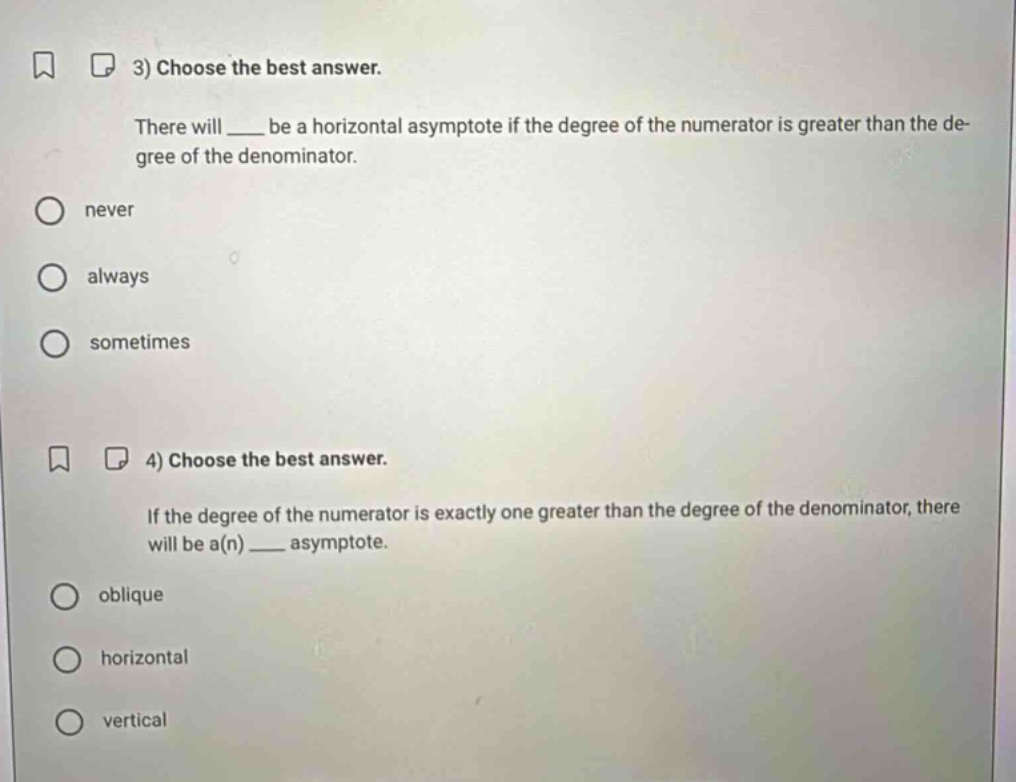
3) choose the best answer. there will ____ be a horizontal asymptote if the degree of the numerator is greater than the degree of the denominator. never always sometimes 4) choose the best answer. if the degree of the numerator is exactly one greater than the degree of the denominator, there will be a(n) ____ asymptote. oblique horizontal vertical
Answer
Explanation:
Step1: Recall asymptote rules
For a rational - function $\frac{f(x)}{g(x)}$, if $\text{deg}(f(x))>\text{deg}(g(x))$, the function has no horizontal asymptote.
Step2: Analyze question 3
Since the degree of the numerator is greater than the degree of the denominator, by the rules of asymptotes for rational functions, there will never be a horizontal asymptote.
Step3: Recall slant - asymptote rule
If the degree of the numerator is exactly one greater than the degree of the denominator of a rational function $\frac{f(x)}{g(x)}$, then the function has an oblique (slant) asymptote.
Step4: Analyze question 4
When the degree of the numerator is exactly one greater than the degree of the denominator, there will be an oblique asymptote.
Answer:
- A. never
- A. oblique