choose the differential equation that has the following slope field.\na. $\frac{dy}{dx}=\frac{x}{y}$\nb…
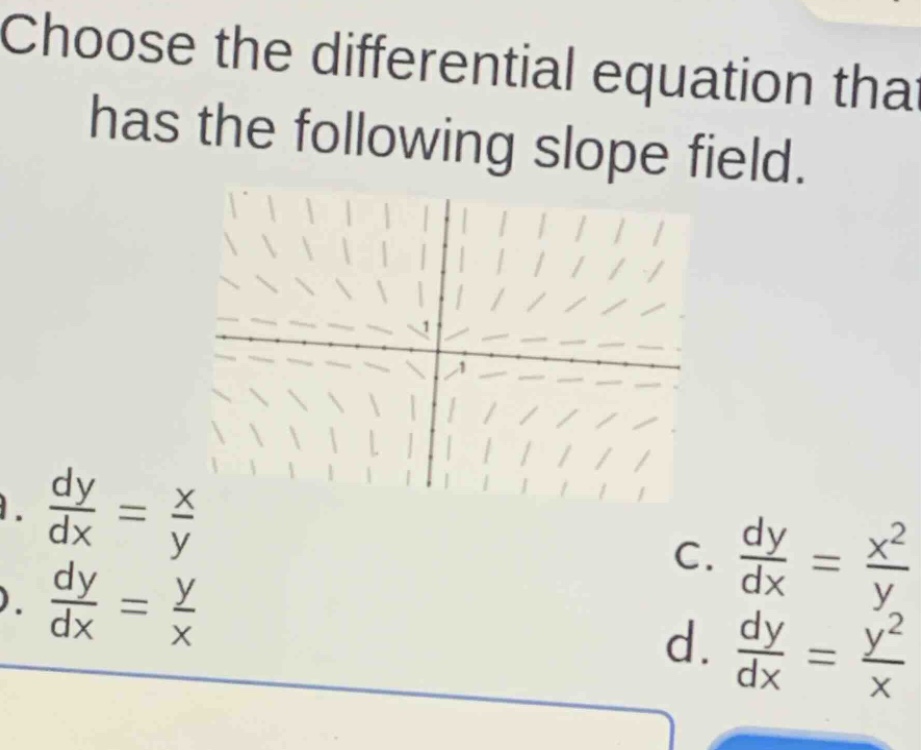
choose the differential equation that has the following slope field.\na. $\frac{dy}{dx}=\frac{x}{y}$\nb. $\frac{dy}{dx}=\frac{y}{x}$\nc. $\frac{dy}{dx}=\frac{x^{2}}{y}$\nd. $\frac{dy}{dx}=\frac{y^{2}}{x}$
Answer
Explanation:
Step1: Analyze slope at key points
Examine the slope - field at points like $(x = 1,y = 1)$, $(x=- 1,y = 1)$, $(x = 1,y=-1)$ and $(x=-1,y=-1)$. For the point $(x = 1,y = 1)$:
- In option a, $\frac{dy}{dx}=\frac{x}{y}=\frac{1}{1}=1$.
- In option b, $\frac{dy}{dx}=\frac{y}{x}=\frac{1}{1}=1$.
- In option c, $\frac{dy}{dx}=\frac{x^{2}}{y}=\frac{1}{1}=1$.
- In option d, $\frac{dy}{dx}=\frac{y^{2}}{x}=\frac{1}{1}=1$. For the point $(x=-1,y = 1)$:
- In option a, $\frac{dy}{dx}=\frac{x}{y}=\frac{-1}{1}=-1$.
- In option b, $\frac{dy}{dx}=\frac{y}{x}=\frac{1}{-1}=-1$.
- In option c, $\frac{dy}{dx}=\frac{x^{2}}{y}=\frac{1}{1}=1$.
- In option d, $\frac{dy}{dx}=\frac{y^{2}}{x}=\frac{1}{-1}=-1$. For the point $(x = 1,y=-1)$:
- In option a, $\frac{dy}{dx}=\frac{x}{y}=\frac{1}{-1}=-1$.
- In option b, $\frac{dy}{dx}=\frac{y}{x}=\frac{-1}{1}=-1$.
- In option c, $\frac{dy}{dx}=\frac{x^{2}}{y}=\frac{1}{-1}=-1$.
- In option d, $\frac{dy}{dx}=\frac{y^{2}}{x}=\frac{1}{1}=1$. For the point $(x=-1,y=-1)$:
- In option a, $\frac{dy}{dx}=\frac{x}{y}=\frac{-1}{-1}=1$.
- In option b, $\frac{dy}{dx}=\frac{y}{x}=\frac{-1}{-1}=1$.
- In option c, $\frac{dy}{dx}=\frac{x^{2}}{y}=\frac{1}{-1}=-1$.
- In option d, $\frac{dy}{dx}=\frac{y^{2}}{x}=\frac{1}{-1}=-1$. We also know that the slope - field is symmetric about the origin. The differential equation $\frac{dy}{dx}=\frac{x}{y}$ has the property that if $(x,y)$ is a point, then at the point $(-x,-y)$ the slope is the same and at points $(x, - y)$ and $(-x,y)$ the slopes are negative of each other.
Step2: Match with slope - field
The slope - field shows that the slopes at points symmetric about the origin have the same magnitude and sign in a way that is consistent with $\frac{dy}{dx}=\frac{x}{y}$.
Answer:
a. $\frac{dy}{dx}=\frac{x}{y}$