(1 + x)^k = ∑(n = 0 to ∞) (k choose n) x^n = 1 + kx + (k(k - 1)/2!)x^2 + (k(k - 1)(k - 2)/3!)x^3 +…
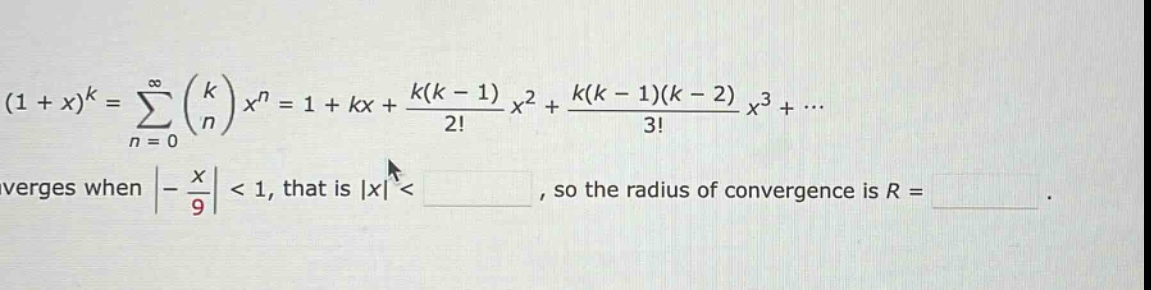
(1 + x)^k = ∑(n = 0 to ∞) (k choose n) x^n = 1 + kx + (k(k - 1)/2!)x^2 + (k(k - 1)(k - 2)/3!)x^3 + ... converges when | - x/9| < 1, that is |x| < , so the radius of convergence is r = .
Answer
Explanation:
Step1: Analyze the given inequality
Given $\left|-\frac{x}{9}\right|<1$. Since $\left|-\frac{x}{9}\right|=\frac{|x|}{9}$, the inequality becomes $\frac{|x|}{9}<1$.
Step2: Solve for $|x|$
Multiply both sides of $\frac{|x|}{9}<1$ by 9. We get $|x|<9$.
Answer:
9