chris launches a rocket straight up into the air. the table below gives the height h(t) of the rocket (in…
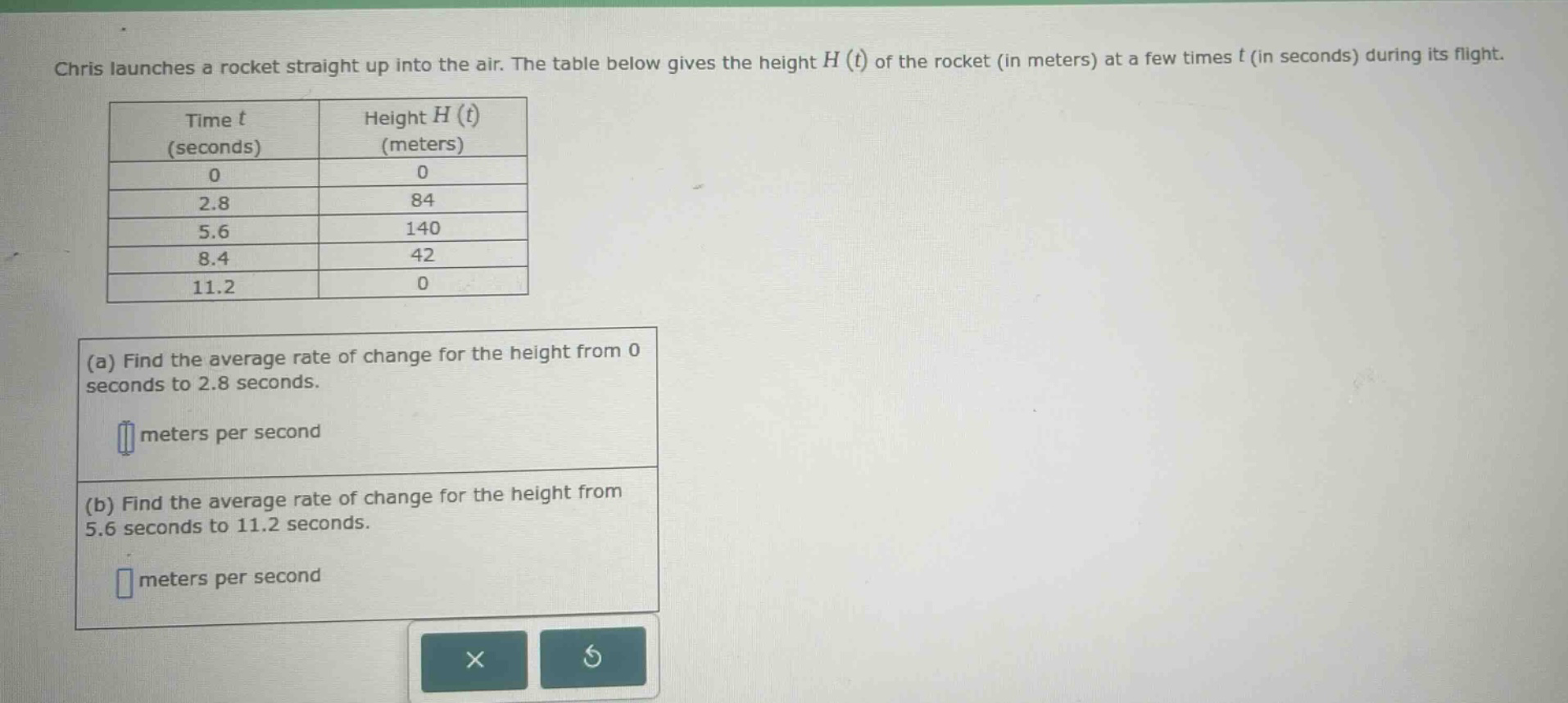
chris launches a rocket straight up into the air. the table below gives the height h(t) of the rocket (in meters) at a few times t (in seconds) during its flight. time t (seconds) height h(t) (meters) 0 0 2.8 84 5.6 140 8.4 42 11.2 0 (a) find the average rate of change for the height from 0 seconds to 2.8 seconds. meters per second (b) find the average rate of change for the height from 5.6 seconds to 11.2 seconds. meters per second
Answer
Answer:
(a) 30 (b) -25
Explanation:
Step1: Recall average - rate - of - change formula
The average rate of change of a function $y = f(x)$ from $x = a$ to $x = b$ is $\frac{f(b)-f(a)}{b - a}$.
Step2: Calculate average rate of change for part (a)
For the time interval from $t = 0$ to $t=2.8$ seconds, $a = 0$, $b = 2.8$, $H(0)=0$, $H(2.8) = 84$. Using the formula $\frac{H(2.8)-H(0)}{2.8 - 0}=\frac{84 - 0}{2.8}=\frac{84}{2.8}=30$ meters per second.
Step3: Calculate average rate of change for part (b)
For the time interval from $t = 5.6$ to $t = 11.2$ seconds, $a = 5.6$, $b = 11.2$, $H(5.6)=140$, $H(11.2)=0$. Using the formula $\frac{H(11.2)-H(5.6)}{11.2 - 5.6}=\frac{0 - 140}{11.2 - 5.6}=\frac{-140}{5.6}=-25$ meters per second.