classify the functions as continuous or discontinuous. f(x)=(x^2 - 14x + 24)/(x^2 + 3x - 28) g(x)=(x^2 - 2x…
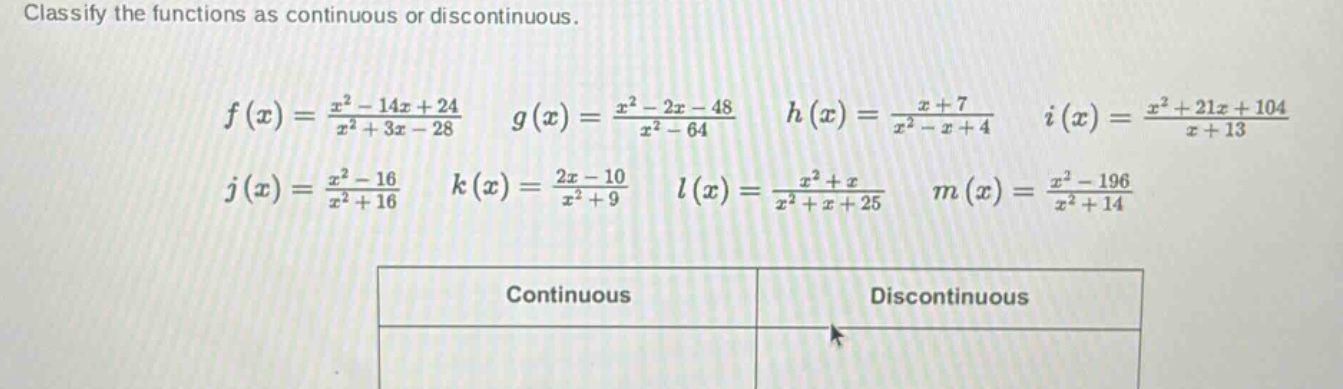
classify the functions as continuous or discontinuous. f(x)=(x^2 - 14x + 24)/(x^2 + 3x - 28) g(x)=(x^2 - 2x - 48)/(x^2 - 64) h(x)=(x + 7)/(x^2 - x + 4) i(x)=(x^2 + 21x + 104)/(x + 13) j(x)=(x^2 - 16)/(x^2 + 16) k(x)=(2x - 10)/(x^2 + 9) l(x)=(x^2 + x)/(x^2 + x + 25) m(x)=(x^2 - 196)/(x^2 + 14) continuous discontinuous
Answer
Explanation:
Step1: Recall continuity condition
A rational - function $y = \frac{p(x)}{q(x)}$ is discontinuous at $x = a$ if $q(a)=0$.
Step2: Analyze $f(x)=\frac{x^{2}-14x + 24}{x^{2}+3x - 28}$
Factor $x^{2}+3x - 28=(x + 7)(x - 4)$. When $x=-7$ or $x = 4$, $q(x)=0$, so $f(x)$ is discontinuous.
Step3: Analyze $g(x)=\frac{x^{2}-2x - 48}{x^{2}-64}$
Factor $x^{2}-64=(x + 8)(x - 8)$. When $x=-8$ or $x = 8$, $q(x)=0$, so $g(x)$ is discontinuous.
Step4: Analyze $h(x)=\frac{x + 7}{x^{2}-x + 4}$
The discriminant of $x^{2}-x + 4$ is $\Delta=(-1)^{2}-4\times4=1 - 16=-15<0$. So $x^{2}-x + 4\neq0$ for all real $x$, and $h(x)$ is continuous.
Step5: Analyze $i(x)=\frac{x^{2}+21x + 104}{x + 13}$
Factor $x^{2}+21x + 104=(x + 8)(x+13)$. When $x=-13$, $q(x)=0$, so $i(x)$ is discontinuous.
Step6: Analyze $j(x)=\frac{x^{2}-16}{x^{2}+16}$
The denominator $x^{2}+16>0$ for all real $x$ since $x^{2}\geq0$ for all real $x$. So $j(x)$ is continuous.
Step7: Analyze $k(x)=\frac{2x - 10}{x^{2}+9}$
The denominator $x^{2}+9>0$ for all real $x$ since $x^{2}\geq0$ for all real $x$. So $k(x)$ is continuous.
Step8: Analyze $l(x)=\frac{x^{2}+x}{x^{2}+x + 25}$
The discriminant of $x^{2}+x + 25$ is $\Delta=1^{2}-4\times25=1 - 100=-99<0$. So $x^{2}+x + 25\neq0$ for all real $x$, and $l(x)$ is continuous.
Step9: Analyze $m(x)=\frac{x^{2}-196}{x^{2}+14}$
The denominator $x^{2}+14>0$ for all real $x$ since $x^{2}\geq0$ for all real $x$. So $m(x)$ is continuous.
Answer:
| Continuous | Discontinuous |
|---|---|
| $h(x),j(x),k(x),l(x),m(x)$ | $f(x),g(x),i(x)$ |