classwork (tear - out page): use the graph of f given below to answer each of the following. *1. a. on what…
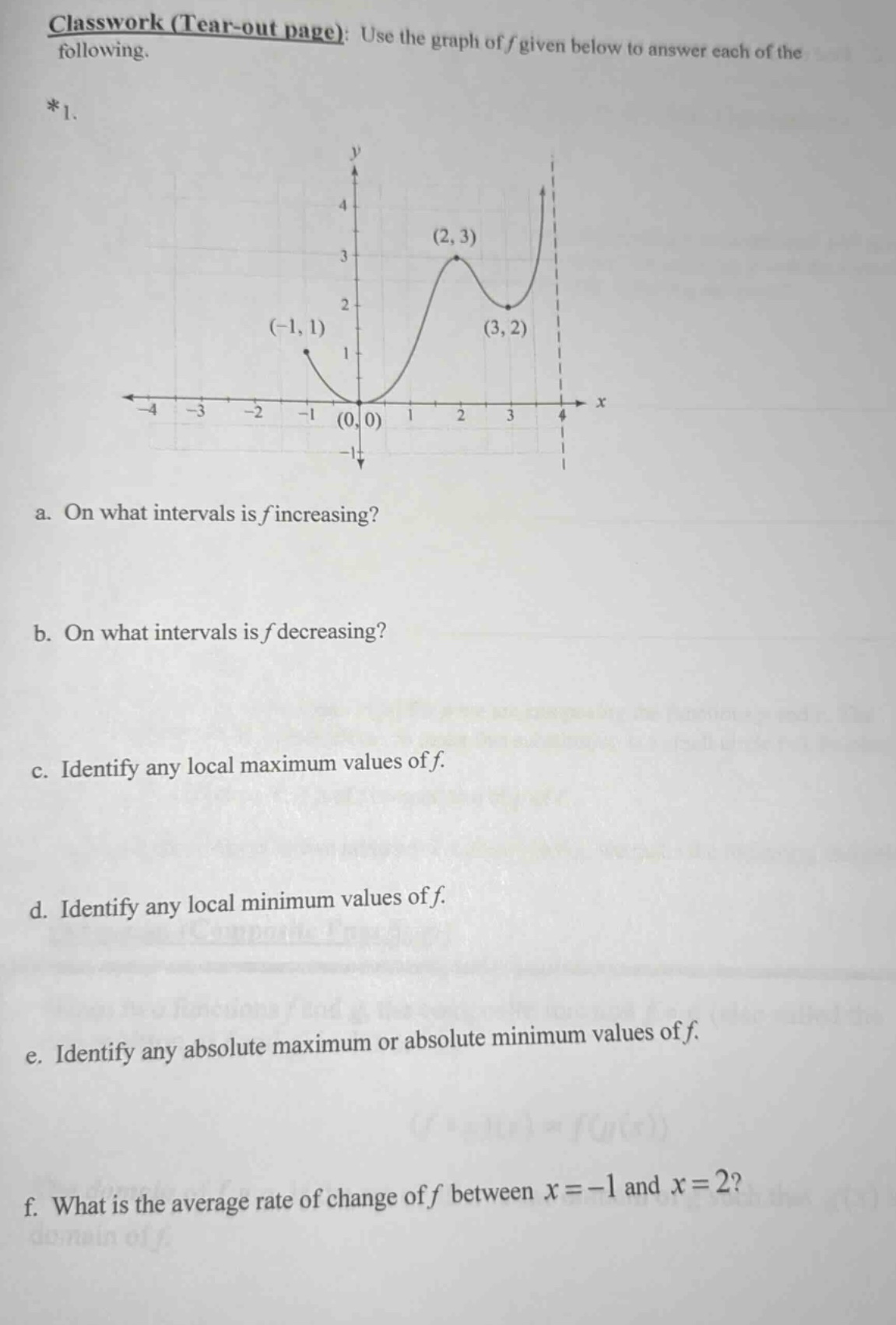
classwork (tear - out page): use the graph of f given below to answer each of the following. *1. a. on what intervals is f increasing? b. on what intervals is f decreasing? c. identify any local maximum values of f. d. identify any local minimum values of f. e. identify any absolute maximum or absolute minimum values of f. f. what is the average rate of change of f between x = - 1 and x = 2?
Answer
Explanation:
Step1: Determine increasing intervals
A function is increasing when the graph goes up from left - to - right. From the graph, $f$ is increasing on the intervals $(-1,2)$ and $(3,4)$.
Step2: Determine decreasing intervals
A function is decreasing when the graph goes down from left - to - right. From the graph, $f$ is decreasing on the intervals $(-4,-1)$ and $(2,3)$.
Step3: Identify local maximum
A local maximum occurs where the function changes from increasing to decreasing. The local maximum value is $y = 3$ at $x = 2$.
Step4: Identify local minimum
A local minimum occurs where the function changes from decreasing to increasing. The local minimum values are $y = 0$ at $x = 0$ and $y = 2$ at $x = 3$.
Step5: Identify absolute maximum and minimum
Since the graph is only shown on a limited domain, and we don't know the behavior outside of it, the absolute minimum value is $y = 0$ at $x = 0$. There is no absolute maximum shown as the graph continues upwards on the right - hand side.
Step6: Calculate average rate of change
The formula for the average rate of change of a function $y = f(x)$ from $x=a$ to $x = b$ is $\frac{f(b)-f(a)}{b - a}$. Here, $a=-1$, $b = 2$, $f(-1)=1$ and $f(2)=3$. So, $\frac{f(2)-f(-1)}{2-(-1)}=\frac{3 - 1}{2+1}=\frac{2}{3}$.
Answer:
a. $(-1,2)$ and $(3,4)$ b. $(-4,-1)$ and $(2,3)$ c. $3$ (at $x = 2$) d. $0$ (at $x = 0$) and $2$ (at $x = 3$) e. Absolute minimum is $0$ (at $x = 0$), no absolute maximum shown f. $\frac{2}{3}$