the coal utility company is burning coal to produce electricity. the following cost function illustrates the…
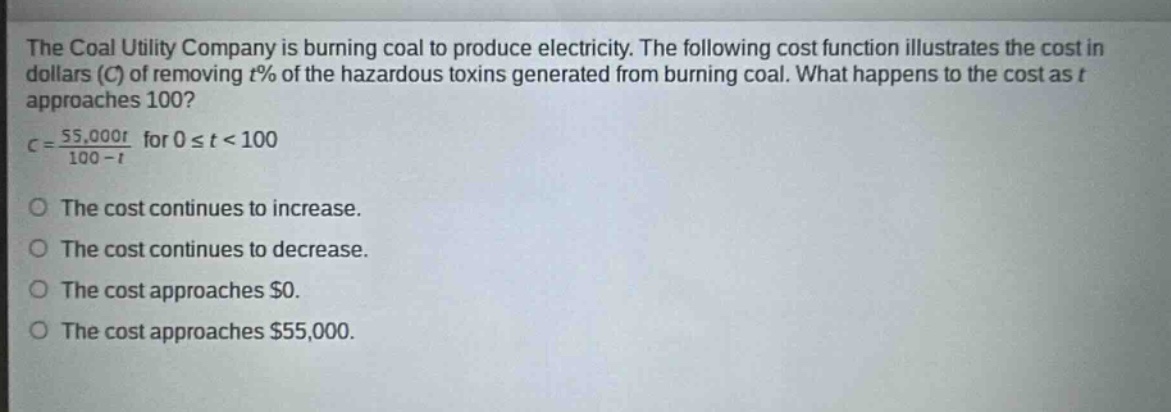
the coal utility company is burning coal to produce electricity. the following cost function illustrates the cost in dollars (c) of removing t% of the hazardous toxins generated from burning coal. what happens to the cost as t approaches 100? c = 55,000t / 100 - t for 0 ≤ t < 100 the cost continues to increase. the cost continues to decrease. the cost approaches $0. the cost approaches $55,000.
Answer
Explanation:
Step1: Analyze the limit
We want to find $\lim_{t\rightarrow100^{-}}\frac{55000t}{100 - t}$. As $t$ approaches $100$ from the left - hand side ($t<100$), the numerator $55000t$ approaches $55000\times100 = 5500000$, and the denominator $100 - t$ approaches $0$ from the positive side.
Step2: Determine the behavior of the function
Since the numerator is a non - zero positive number and the denominator is approaching $0$ from the positive side, $\lim_{t\rightarrow100^{-}}\frac{55000t}{100 - t}=\infty$. This means the cost continues to increase.
Answer:
The cost continues to increase.