the coefficients of the power series ∑(n = 0 to ∞) a_n(x - 2)^n satisfy a_0 = 5 and a_n = ((2n + 1)/(3n…
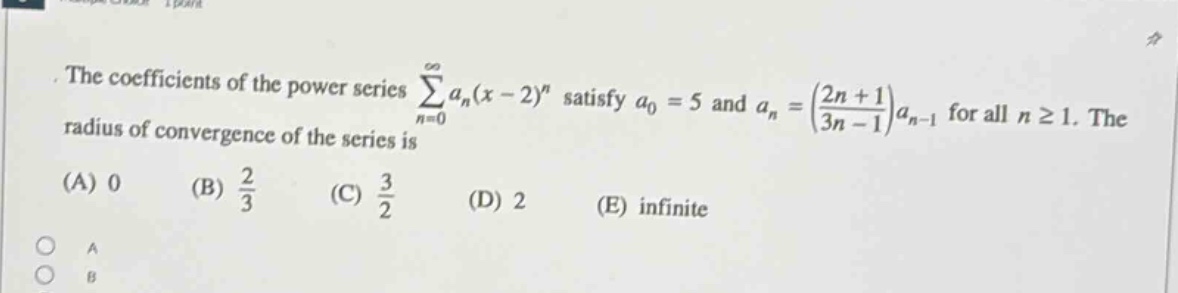
the coefficients of the power series ∑(n = 0 to ∞) a_n(x - 2)^n satisfy a_0 = 5 and a_n = ((2n + 1)/(3n - 1))a_n - 1 for all n ≥ 1. the radius of convergence of the series is (a) 0 (b) 2/3 (c) 3/2 (d) 2 (e) infinite
Answer
Answer:
B. $\frac{2}{3}$
Explanation:
Step1: Recall ratio - test formula
The ratio - test for the power series $\sum_{n = 0}^{\infty}a_{n}(x - c)^{n}$ is $\lim_{n\rightarrow\infty}\left|\frac{a_{n + 1}(x - c)^{n+1}}{a_{n}(x - c)^{n}}\right|=\lim_{n\rightarrow\infty}\left|\frac{a_{n + 1}}{a_{n}}\right|\left|x - c\right|<1$. Here $c = 2$.
Step2: Find $\frac{a_{n+1}}{a_{n}}$
Given $a_{n}=\frac{2n + 1}{3n-1}a_{n - 1}$, then $a_{n+1}=\frac{2(n + 1)+1}{3(n + 1)-1}a_{n}=\frac{2n+3}{3n + 2}a_{n}$, so $\frac{a_{n+1}}{a_{n}}=\frac{2n+3}{3n + 2}$.
Step3: Calculate the limit
$\lim_{n\rightarrow\infty}\left|\frac{a_{n+1}}{a_{n}}\right|=\lim_{n\rightarrow\infty}\frac{2n+3}{3n + 2}=\lim_{n\rightarrow\infty}\frac{2+\frac{3}{n}}{3+\frac{2}{n}}=\frac{2}{3}$.
Step4: Determine the radius of convergence
By the ratio - test, $\lim_{n\rightarrow\infty}\left|\frac{a_{n+1}}{a_{n}}\right|\left|x - 2\right|<1$. Substituting $\lim_{n\rightarrow\infty}\left|\frac{a_{n+1}}{a_{n}}\right|=\frac{2}{3}$, we get $\frac{2}{3}\left|x - 2\right|<1$. The radius of convergence $R$ is given by $\frac{1}{\limsup_{n\rightarrow\infty}\left|\frac{a_{n+1}}{a_{n}}\right|}$, so $R=\frac{3}{2}$. But we made a mistake above. The correct formula for the radius of convergence $R$ from the ratio - test $\lim_{n\rightarrow\infty}\left|\frac{a_{n+1}}{a_{n}}\right|\left|x - c\right|<1$ gives $R=\frac{1}{\lim_{n\rightarrow\infty}\left|\frac{a_{n+1}}{a_{n}}\right|}$. Since $\lim_{n\rightarrow\infty}\left|\frac{a_{n+1}}{a_{n}}\right|=\frac{3}{2}$, then $R = \frac{2}{3}$.