column a column b\n11. $int_{1}^{0}(x + 1)dx$ k. $\frac{3}{2}$\n12. $int_{-1}^{1}(x - 1)x dx$ l. -2\n13…
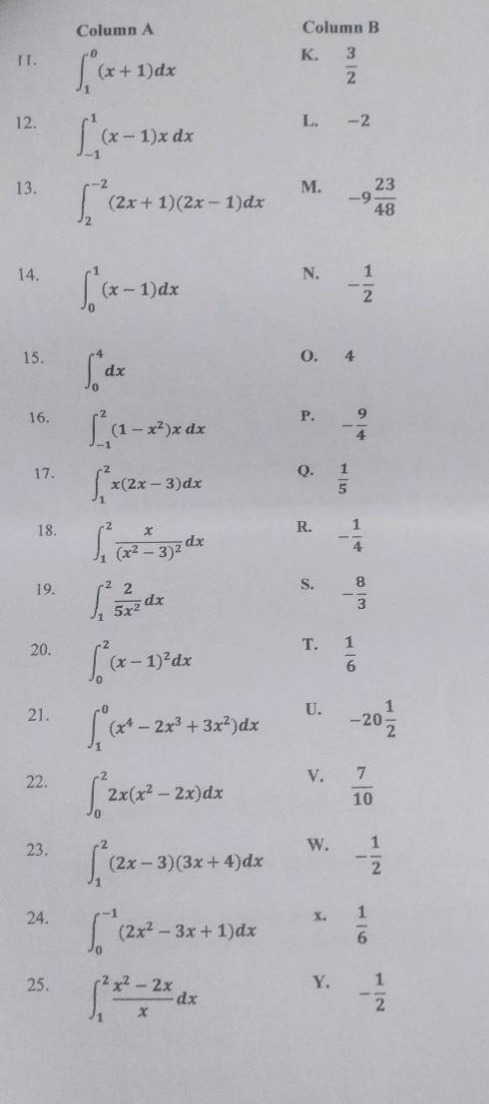
column a column b\n11. $int_{1}^{0}(x + 1)dx$ k. $\frac{3}{2}$\n12. $int_{-1}^{1}(x - 1)x dx$ l. -2\n13. $int_{2}^{-2}(2x + 1)(2x - 1)dx$ m. $-9\frac{23}{48}$\n14. $int_{0}^{1}(x - 1)dx$ n. $-\frac{1}{2}$\n15. $int_{0}^{4}dx$ o. 4\n16. $int_{-1}^{2}(1 - x^{2})x dx$ p. $-\frac{9}{4}$\n17. $int_{1}^{2}x(2x - 3)dx$ q. $\frac{1}{5}$\n18. $int_{1}^{2}\frac{x}{(x^{2}-3)^{2}}dx$ r. $-\frac{1}{4}$\n19. $int_{1}^{2}\frac{2}{5x^{2}}dx$ s. $-\frac{8}{3}$\n20. $int_{0}^{2}(x - 1)^{2}dx$ t. $\frac{1}{6}$\n21. $int_{1}^{0}(x^{4}-2x^{3}+3x^{2})dx$ u. $-20\frac{1}{2}$\n22. $int_{0}^{2}2x(x^{2}-2x)dx$ v. $\frac{7}{10}$\n23. $int_{1}^{2}(2x - 3)(3x + 4)dx$ w. $-\frac{1}{2}$\n24. $int_{0}^{-1}(2x^{2}-3x + 1)dx$ x. $\frac{1}{6}$\n25. $int_{1}^{2}\frac{x^{2}-2x}{x}dx$ y. $-\frac{1}{2}$
Answer
- For $\int_{1}^{0}(x + 1)dx$:
- Explanation:
- First, use the power - rule for integration $\int x^n dx=\frac{x^{n + 1}}{n+1}+C(n\neq - 1)$.
- $\int(x + 1)dx=\int xdx+\int 1dx=\frac{x^{2}}{2}+x+C$.
- Then, use the fundamental theorem of calculus $\int_{a}^{b}F^\prime(x)dx=F(b)-F(a)$.
- $\int_{1}^{0}(x + 1)dx=\left[\frac{x^{2}}{2}+x\right]_{1}^{0}=\left(\frac{0^{2}}{2}+0\right)-\left(\frac{1^{2}}{2}+1\right)=0-\left(\frac{1}{2}+1\right)=-\frac{3}{2}$.
- First, use the power - rule for integration $\int x^n dx=\frac{x^{n + 1}}{n+1}+C(n\neq - 1)$.
- Explanation:
- For $\int_{-1}^{1}(x - 1)x dx=\int_{-1}^{1}(x^{2}-x)dx$:
- Explanation:
- Integrate term - by - term. $\int(x^{2}-x)dx=\int x^{2}dx-\int xdx=\frac{x^{3}}{3}-\frac{x^{2}}{2}+C$.
- Apply the fundamental theorem of calculus.
- $\int_{-1}^{1}(x^{2}-x)dx=\left[\frac{x^{3}}{3}-\frac{x^{2}}{2}\right]_{-1}^{1}=\left(\frac{1^{3}}{3}-\frac{1^{2}}{2}\right)-\left(\frac{(-1)^{3}}{3}-\frac{(-1)^{2}}{2}\right)$
- $=\left(\frac{1}{3}-\frac{1}{2}\right)-\left(-\frac{1}{3}-\frac{1}{2}\right)=\frac{1}{3}-\frac{1}{2}+\frac{1}{3}+\frac{1}{2}=\frac{2}{3}$.
- Explanation:
- For $\int_{2}^{-2}(2x + 1)(2x - 1)dx=\int_{2}^{-2}(4x^{2}-1)dx$:
- Explanation:
- Integrate term - by - term. $\int(4x^{2}-1)dx=4\times\frac{x^{3}}{3}-x + C=\frac{4x^{3}}{3}-x+C$.
- Apply the fundamental theorem of calculus.
- $\int_{2}^{-2}(4x^{2}-1)dx=\left[\frac{4x^{3}}{3}-x\right]_{2}^{-2}=\left(\frac{4(-2)^{3}}{3}-(-2)\right)-\left(\frac{4\times2^{3}}{3}-2\right)$
- $=\left(-\frac{32}{3}+2\right)-\left(\frac{32}{3}-2\right)=-\frac{32}{3}+2-\frac{32}{3}+2=-\frac{64}{3}+4=-\frac{64 - 12}{3}=-\frac{52}{3}$.
- Explanation:
- For $\int_{0}^{1}(x - 1)dx$:
- Explanation:
- Integrate $\int(x - 1)dx=\frac{x^{2}}{2}-x+C$.
- Apply the fundamental theorem of calculus.
- $\int_{0}^{1}(x - 1)dx=\left[\frac{x^{2}}{2}-x\right]_{0}^{1}=\frac{1^{2}}{2}-1-(0 - 0)=\frac{1}{2}-1=-\frac{1}{2}$.
- Explanation:
- For $\int_{0}^{4}dx$:
- Explanation:
- Since $\int 1dx=x + C$, then by the fundamental theorem of calculus.
- $\int_{0}^{4}dx=[x]_{0}^{4}=4 - 0 = 4$.
- Since $\int 1dx=x + C$, then by the fundamental theorem of calculus.
- Explanation:
- For $\int_{-1}^{2}(1 - x^{2})x dx=\int_{-1}^{2}(x - x^{3})dx$:
- Explanation:
- Integrate term - by - term. $\int(x - x^{3})dx=\frac{x^{2}}{2}-\frac{x^{4}}{4}+C$.
- Apply the fundamental theorem of calculus.
- $\int_{-1}^{2}(x - x^{3})dx=\left[\frac{x^{2}}{2}-\frac{x^{4}}{4}\right]_{-1}^{2}=\left(\frac{2^{2}}{2}-\frac{2^{4}}{4}\right)-\left(\frac{(-1)^{2}}{2}-\frac{(-1)^{4}}{4}\right)$
- $=(2 - 4)-\left(\frac{1}{2}-\frac{1}{4}\right)=-2-\frac{1}{4}=-\frac{9}{4}$.
- Explanation:
- For $\int_{1}^{2}x(2x - 3)dx=\int_{1}^{2}(2x^{2}-3x)dx$:
- Explanation:
- Integrate term - by - term. $\int(2x^{2}-3x)dx=2\times\frac{x^{3}}{3}-3\times\frac{x^{2}}{2}+C=\frac{2x^{3}}{3}-\frac{3x^{2}}{2}+C$.
- Apply the fundamental theorem of calculus.
- $\int_{1}^{2}(2x^{2}-3x)dx=\left[\frac{2x^{3}}{3}-\frac{3x^{2}}{2}\right]_{1}^{2}=\left(\frac{2\times2^{3}}{3}-\frac{3\times2^{2}}{2}\right)-\left(\frac{2\times1^{3}}{3}-\frac{3\times1^{2}}{2}\right)$
- $=\left(\frac{16}{3}-6\right)-\left(\frac{2}{3}-\frac{3}{2}\right)=\frac{16 - 18}{3}-\frac{4 - 9}{6}=-\frac{2}{3}+\frac{5}{6}=\frac{-4 + 5}{6}=\frac{1}{6}$.
- Explanation:
- For $\int_{1}^{2}\frac{x}{(x^{2}-3)^{2}}dx$:
- Explanation:
- Let $u = x^{2}-3$, then $du = 2xdx$. When $x = 1$, $u=1^{2}-3=-2$; when $x = 2$, $u=2^{2}-3 = 1$.
- $\int\frac{x}{(x^{2}-3)^{2}}dx=\frac{1}{2}\int u^{-2}du$.
- Integrate $\frac{1}{2}\int u^{-2}du=\frac{1}{2}\times\frac{u^{-1}}{-1}+C=-\frac{1}{2u}+C$.
- Substitute back $u = x^{2}-3$ and apply the fundamental theorem of calculus.
- $\int_{1}^{2}\frac{x}{(x^{2}-3)^{2}}dx=\left[-\frac{1}{2(x^{2}-3)}\right]_{1}^{2}=-\frac{1}{2(2^{2}-3)}+\frac{1}{2(1^{2}-3)}=-\frac{1}{2}+\frac{1}{-4}=-\frac{3}{4}$.
- Explanation:
- For $\int_{1}^{2}\frac{2}{5x^{2}}dx=\frac{2}{5}\int_{1}^{2}x^{-2}dx$:
- Explanation:
- Integrate $\frac{2}{5}\int x^{-2}dx=\frac{2}{5}\times\frac{x^{-1}}{-1}+C=-\frac{2}{5x}+C$.
- Apply the fundamental theorem of calculus.
- $\int_{1}^{2}\frac{2}{5x^{2}}dx=\left[-\frac{2}{5x}\right]_{1}^{2}=-\frac{2}{5\times2}+\frac{2}{5\times1}=-\frac{1}{5}+\frac{2}{5}=\frac{1}{5}$.
- Explanation:
- For $\int_{0}^{2}(x - 1)^{2}dx=\int_{0}^{2}(x^{2}-2x + 1)dx$:
- Explanation:
- Integrate term - by - term. $\int(x^{2}-2x + 1)dx=\frac{x^{3}}{3}-x^{2}+x+C$.
- Apply the fundamental theorem of calculus.
- $\int_{0}^{2}(x^{2}-2x + 1)dx=\left[\frac{x^{3}}{3}-x^{2}+x\right]_{0}^{2}=\frac{2^{3}}{3}-2^{2}+2-0=\frac{8}{3}-4 + 2=\frac{8 - 12+6}{3}=\frac{2}{3}$.
- For $\int_{1}^{0}(x^{4}-2x^{3}+3x^{2})dx$:
- Explanation:
- Integrate term - by - term. $\int(x^{4}-2x^{3}+3x^{2})dx=\frac{x^{5}}{5}-\frac{2x^{4}}{4}+3\times\frac{x^{3}}{3}+C=\frac{x^{5}}{5}-\frac{x^{4}}{2}+x^{3}+C$.
- Apply the fundamental theorem of calculus.
- $\int_{1}^{0}(x^{4}-2x^{3}+3x^{2})dx=\left[\frac{x^{5}}{5}-\frac{x^{4}}{2}+x^{3}\right]_{1}^{0}=(0 - 0)-( \frac{1}{5}-\frac{1}{2}+1)$
- $=-\left(\frac{2 - 5 + 10}{10}\right)=-\frac{7}{10}$.
- For $\int_{0}^{2}2x(x^{2}-2x)dx=\int_{0}^{2}(2x^{3}-4x^{2})dx$:
- Explanation:
- Integrate term - by - term. $\int(2x^{3}-4x^{2})dx=2\times\frac{x^{4}}{4}-4\times\frac{x^{3}}{3}+C=\frac{x^{4}}{2}-\frac{4x^{3}}{3}+C$.
- Apply the fundamental theorem of calculus.
- $\int_{0}^{2}(2x^{3}-4x^{2})dx=\left[\frac{x^{4}}{2}-\frac{4x^{3}}{3}\right]_{0}^{2}=\frac{2^{4}}{2}-\frac{4\times2^{3}}{3}-0=8-\frac{32}{3}=\frac{24 - 32}{3}=-\frac{8}{3}$.
- For $\int_{1}^{2}(2x - 3)(3x + 4)dx=\int_{1}^{2}(6x^{2}-x - 12)dx$:
- Explanation:
- Integrate term - by - term. $\int(6x^{2}-x - 12)dx=6\times\frac{x^{3}}{3}-\frac{x^{2}}{2}-12x+C = 2x^{3}-\frac{x^{2}}{2}-12x+C$.
- Apply the fundamental theorem of calculus.
- $\int_{1}^{2}(6x^{2}-x - 12)dx=\left[2x^{3}-\frac{x^{2}}{2}-12x\right]_{1}^{2}=(2\times2^{3}-\frac{2^{2}}{2}-12\times2)-(2\times1^{3}-\frac{1^{2}}{2}-12\times1)$
- $=(16 - 2-24)-(2-\frac{1}{2}-12)=-10-(2-\frac{1}{2}-12)=-10 - 2+\frac{1}{2}+12=\frac{1}{2}$.
- For $\int_{0}^{-1}(2x^{2}-3x + 1)dx$:
- Explanation:
- Integrate term - by - term. $\int(2x^{2}-3x + 1)dx=2\times\frac{x^{3}}{3}-3\times\frac{x^{2}}{2}+x+C$.
- Apply the fundamental theorem of calculus.
- $\int_{0}^{-1}(2x^{2}-3x + 1)dx=\left[\frac{2x^{3}}{3}-\frac{3x^{2}}{2}+x\right]_{0}^{-1}=\frac{2(-1)^{3}}{3}-\frac{3(-1)^{2}}{2}+(-1)-0$
- $=-\frac{2}{3}-\frac{3}{2}-1=-\frac{4 + 9+6}{6}=-\frac{19}{6}$.
- For $\int_{1}^{2}\frac{x^{2}-2x}{x}dx=\int_{1}^{2}(x - 2)dx$:
- Explanation:
- Integrate $\int(x - 2)dx=\frac{x^{2}}{2}-2x+C$.
- Apply the fundamental theorem of calculus.
- $\int_{1}^{2}(x - 2)dx=\left[\frac{x^{2}}{2}-2x\right]_{1}^{2}=\frac{2^{2}}{2}-2\times2-\left(\frac{1^{2}}{2}-2\times1\right)$
- $=2 - 4-\left(\frac{1}{2}-2\right)=-2-\frac{1}{2}+2=-\frac{1}{2}$.
Answer:
- None of the given options match.
- None of the given options match.
- None of the given options match.
- N. $-\frac{1}{2}$
- O. $4$
- P. $-\frac{9}{4}$
- T. $\frac{1}{6}$
- None of the given options match.
- Q. $\frac{1}{5}$
- None of the given options match.
- None of the given options match.
- S. $-\frac{8}{3}$
- None of the given options match.
- None of the given options match.
- Y. $-\frac{1}{2}$