a companys total cost, in millions of dollars, is given by c(t)=80 - 60e^(-t) where t is the time in years…
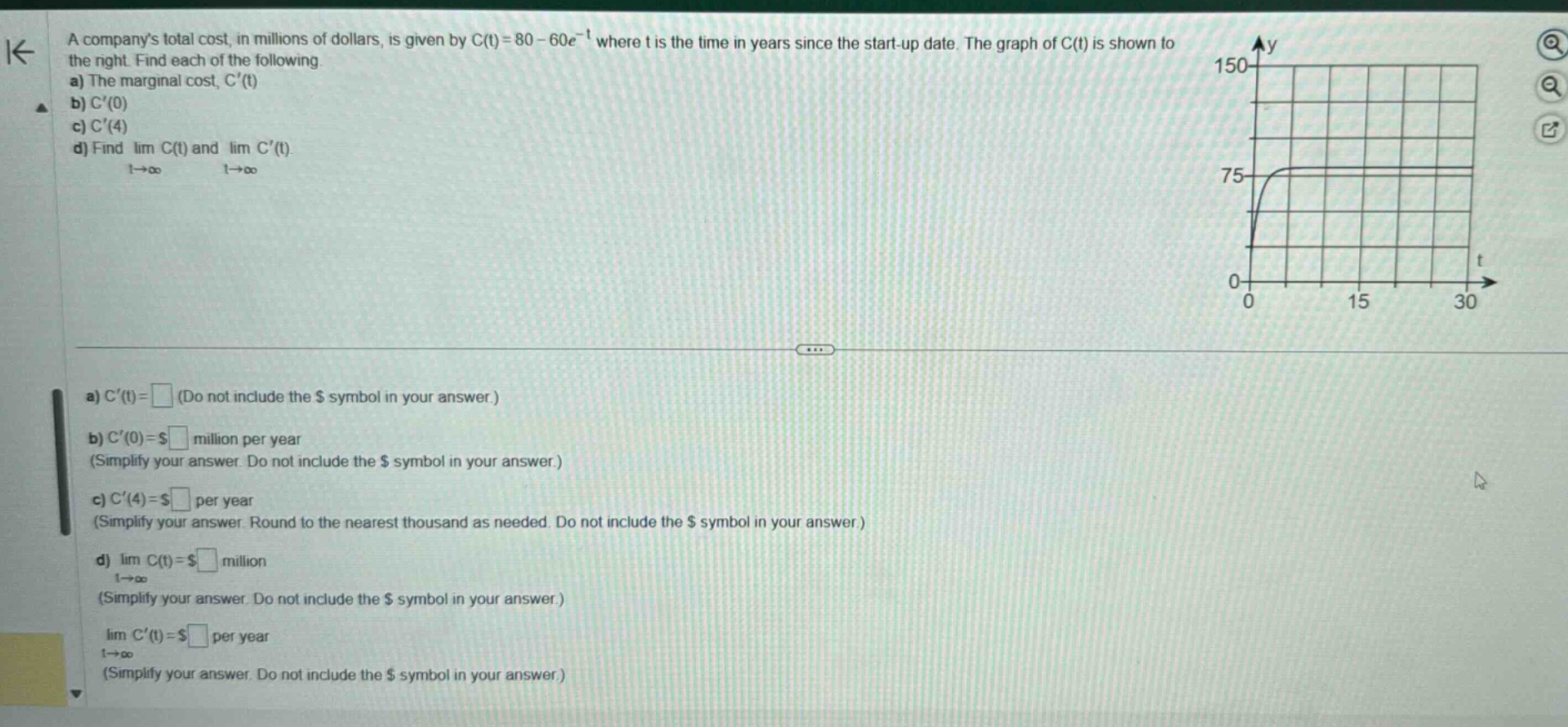
a companys total cost, in millions of dollars, is given by c(t)=80 - 60e^(-t) where t is the time in years since the start - up date. the graph of c(t) is shown to the right. find each of the following. a) the marginal cost, c(t) b) c(0) c) c(4) d) find lim c(t) and lim c(t) as t→∞. a) c(t)= (do not include the $ symbol in your answer.) b) c(0)=$ million per year (simplify your answer. do not include the $ symbol in your answer.) c) c(4)=$ per year (simplify your answer. round to the nearest thousand as needed. do not include the $ symbol in your answer.) d) lim c(t)=$ million as t→∞ (simplify your answer. do not include the $ symbol in your answer.) lim c(t)=$ per year as t→∞ (simplify your answer. do not include the $ symbol in your answer.)
Answer
Explanation:
Step1: Find the derivative of C(t)
The derivative of a constant is 0, and the derivative of $e^{-t}$ is $-e^{-t}$. Using the constant - multiple rule, if $C(t)=80 - 60e^{-t}$, then $C^{\prime}(t)=0-60\times(-e^{-t}) = 60e^{-t}$.
Step2: Evaluate C'(0)
Substitute $t = 0$ into $C^{\prime}(t)$. Since $e^{0}=1$, then $C^{\prime}(0)=60\times e^{0}=60$.
Step3: Evaluate C'(4)
Substitute $t = 4$ into $C^{\prime}(t)$. $C^{\prime}(4)=60e^{-4}$. Using a calculator, $e^{-4}\approx0.018316$, so $C^{\prime}(4)=60\times0.018316 = 1.09896\approx1.100$.
Step4: Find $\lim_{t\rightarrow\infty}C(t)$
We know that $\lim_{t\rightarrow\infty}e^{-t}=0$. So, $\lim_{t\rightarrow\infty}C(t)=\lim_{t\rightarrow\infty}(80 - 60e^{-t})=80-60\times0 = 80$.
Step5: Find $\lim_{t\rightarrow\infty}C^{\prime}(t)$
Since $\lim_{t\rightarrow\infty}e^{-t}=0$, then $\lim_{t\rightarrow\infty}C^{\prime}(t)=\lim_{t\rightarrow\infty}(60e^{-t})=60\times0 = 0$.
Answer:
a) $60e^{-t}$ b) $60$ c) $1.100$ d) $\lim_{t\rightarrow\infty}C(t)=80$, $\lim_{t\rightarrow\infty}C^{\prime}(t)=0$