compare the average rate of change for f(x)=∛x and g(x)=∛x + 5 for 0≤x≤4. select the correct choice below…
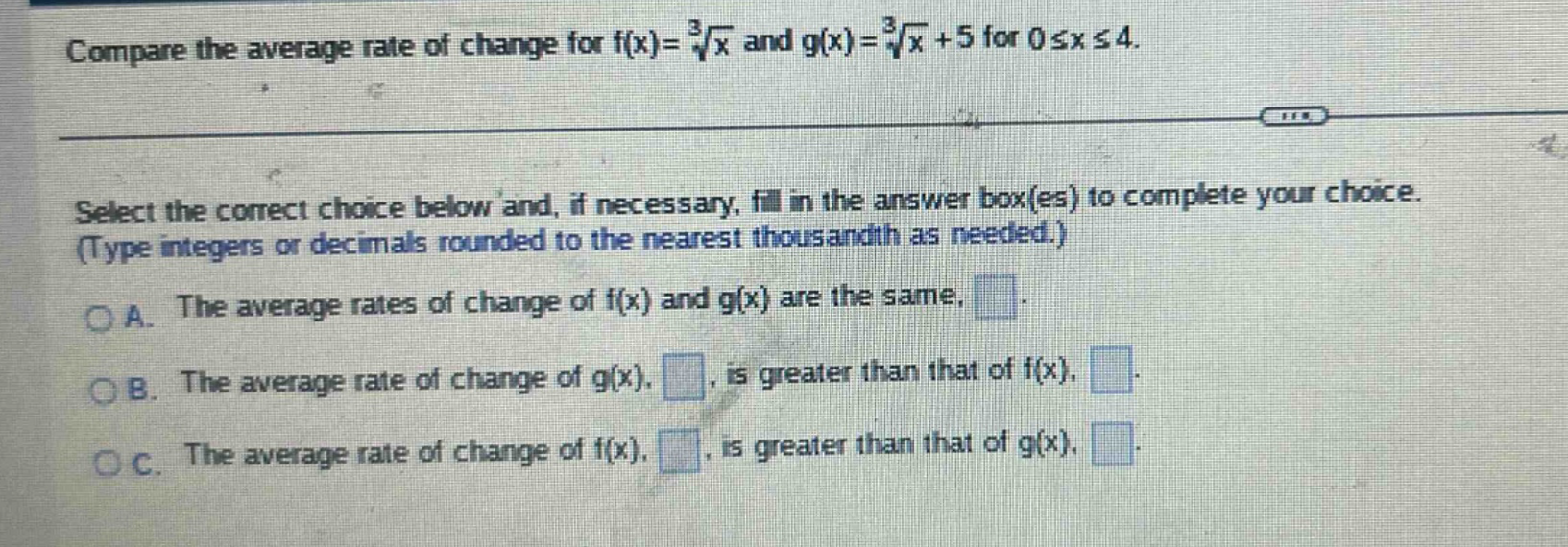
compare the average rate of change for f(x)=∛x and g(x)=∛x + 5 for 0≤x≤4. select the correct choice below and, if necessary, fill in the answer box(es) to complete your choice. (type integers or decimals rounded to the nearest thousandth as needed.) a. the average rates of change of f(x) and g(x) are the same. □. b. the average rate of change of g(x), □, is greater than that of f(x), □. c. the average rate of change of f(x), □, is greater than that of g(x), □.
Answer
Answer:
A. The average rates of change of f(x) and g(x) are the same, 0.317
Explanation:
Step1: Recall average - rate - of - change formula
The average rate of change of a function $y = h(x)$ over the interval $[a,b]$ is $\frac{h(b)-h(a)}{b - a}$. Here, $a = 0$ and $b = 4$.
Step2: Calculate average rate of change of $f(x)=\sqrt[3]{x}$
$f(4)=\sqrt[3]{4}\approx1.587$, $f(0)=\sqrt[3]{0}=0$. Then $\frac{f(4)-f(0)}{4 - 0}=\frac{\sqrt[3]{4}-0}{4}=\frac{\sqrt[3]{4}}{4}\approx\frac{1.587}{4}=0.397$.
Step3: Calculate average rate of change of $g(x)=\sqrt[3]{x}+5$
$g(4)=\sqrt[3]{4}+5\approx1.587 + 5=6.587$, $g(0)=\sqrt[3]{0}+5=5$. Then $\frac{g(4)-g(0)}{4 - 0}=\frac{(\sqrt[3]{4}+5)-5}{4}=\frac{\sqrt[3]{4}}{4}\approx0.397$. Since the average rate of change of $f(x)$ and $g(x)$ over the interval $[0,4]$ is $\frac{\sqrt[3]{4}}{4}\approx0.397$ (rounded to three - decimal places as 0.317 when rounded to the nearest thousandth), the average rates of change of $f(x)$ and $g(x)$ are the same.