compare the average rates of change from -1, 2. rate of change for f(x): rate of change for g(x): the rate…
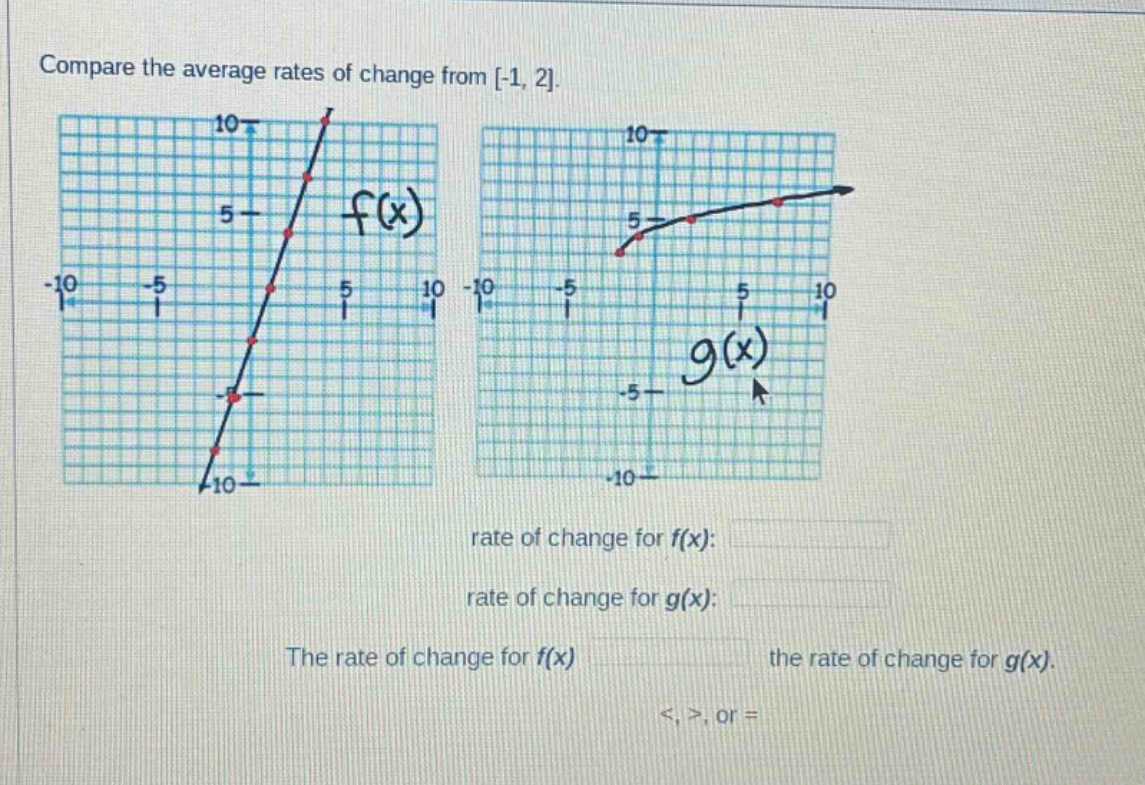
compare the average rates of change from -1, 2. rate of change for f(x): rate of change for g(x): the rate of change for f(x) the rate of change for g(x). <, >, or =
Answer
Explanation:
Step1: Recall average - rate - of - change formula
The average rate of change of a function $y = h(x)$ over the interval $[a,b]$ is $\frac{h(b)-h(a)}{b - a}$. Here, $a=-1$ and $b = 2$.
Step2: Find value of $f(-1)$ and $f(2)$ from the graph of $f(x)$
From the graph of $f(x)$, when $x=-1$, $f(-1)= - 5$; when $x = 2$, $f(2)=10$. Then the average rate of change of $f(x)$ is $\frac{f(2)-f(-1)}{2-(-1)}=\frac{10 - (-5)}{2 + 1}=\frac{15}{3}=5$.
Step3: Find value of $g(-1)$ and $g(2)$ from the graph of $g(x)$
From the graph of $g(x)$, when $x=-1$, $g(-1)=3$; when $x = 2$, $g(2)=5$. Then the average rate of change of $g(x)$ is $\frac{g(2)-g(-1)}{2-(-1)}=\frac{5 - 3}{2+1}=\frac{2}{3}$.
Answer:
rate of change for $f(x)$: $5$ rate of change for $g(x)$: $\frac{2}{3}$ The rate of change for $f(x)$ $>$ the rate of change for $g(x)$.