compare the key features of the graphs of m(t) and s(t) within the context of the problem, including y…
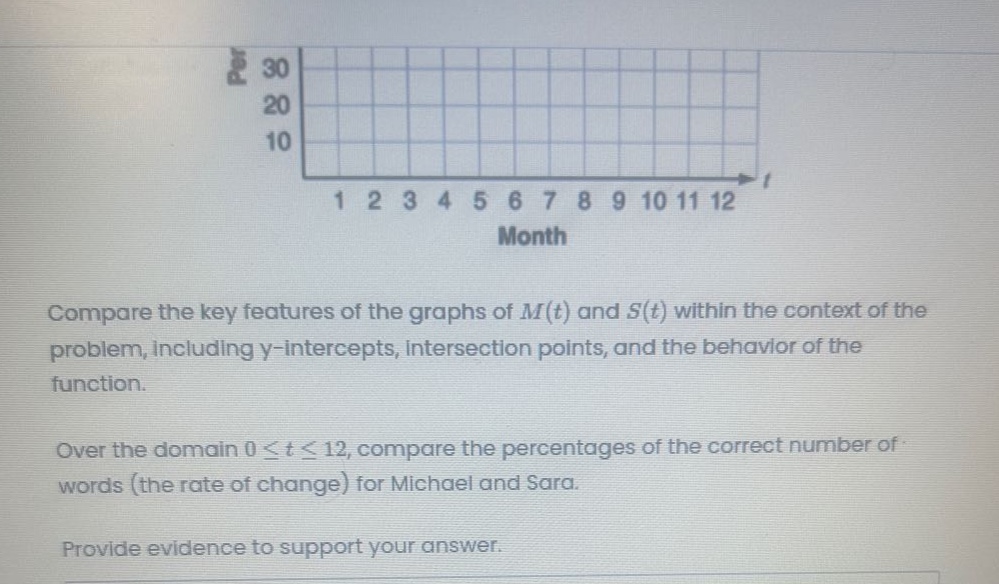
compare the key features of the graphs of m(t) and s(t) within the context of the problem, including y - intercepts, intersection points, and the behavior of the function. over the domain 0 ≤ t ≤ 12, compare the percentages of the correct number of words (the rate of change) for michael and sara. provide evidence to support your answer.
Answer
Explanation:
Step1: Identify y - intercepts
Find the value of the functions at (t = 0). For (M(t)) and (S(t)), the y - intercept is the percentage of correct words at the start ((t=0)). Check the graphs of (M(t)) and (S(t)) at (t = 0) to get the initial values.
Step2: Find intersection points
Set (M(t)=S(t)) and solve for (t) within the domain (0\leq t\leq12). Graphically, this is where the two graphs cross. If there are no algebraic equations given, estimate from the graph.
Step3: Analyze function behavior
Observe if (M(t)) and (S(t)) are increasing, decreasing or constant over different intervals in (0\leq t\leq12). For example, if the graph is going up, the function is increasing.
Step4: Calculate rate of change
The rate of change of a function (y = f(t)) over the interval ([a,b]) is (\frac{f(b)-f(a)}{b - a}). For (M(t)) and (S(t)) over (0\leq t\leq12), calculate (\frac{M(12)-M(0)}{12 - 0}) and (\frac{S(12)-S(0)}{12 - 0}) respectively. Compare these two values.
Answer:
The y - intercepts give the starting percentages of correct words. Intersection points show when Michael and Sara have the same percentage of correct words. Function behavior shows improvement or decline over time. The rate of change calculations for (M(t)) and (S(t)) over (0\leq t\leq12) will show which one has a steeper increase (or decrease) in the percentage of correct words. Provide specific values from the graph for the y - intercepts, intersection points (estimated if needed), and calculated rate - of - change values for evidence.