compare the magnitude of the estimated average rates of change of the exponential function pictured above…
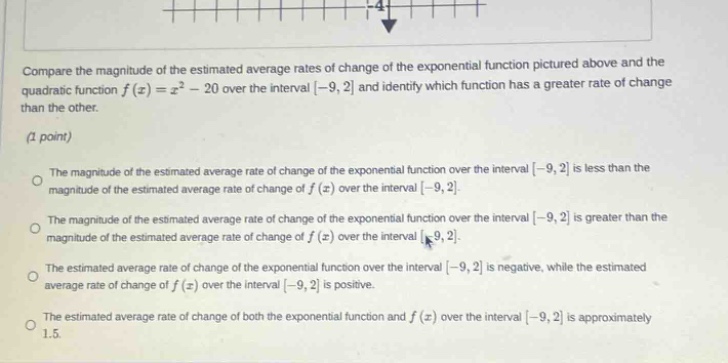
compare the magnitude of the estimated average rates of change of the exponential function pictured above and the quadratic function f(x)=x² - 20 over the interval -9,2 and identify which function has a greater rate of change than the other. (1 point) the magnitude of the estimated average rate of change of the exponential function over the interval -9,2 is less than the magnitude of the estimated average rate of change of f(x) over the interval -9,2. the magnitude of the estimated average rate of change of the exponential function over the interval -9,2 is greater than the magnitude of the estimated average rate of change of f(x) over the interval -9,2. the estimated average rate of change of the exponential function over the interval -9,2 is negative, while the estimated average rate of change of f(x) over the interval -9,2 is positive. the estimated average rate of change of both the exponential function and f(x) over the interval -9,2 is approximately 1.5.
Answer
Answer:
Para resolver este problema, primero debemos recordar la fórmula para el valor promedio de la tasa de cambio de una función $y = f(x)$ en el intervalo $[a,b]$ que es $\frac{f(b)-f(a)}{b - a}$.
Para la función cuadrática $f(x)=x^{2}-20$ en el intervalo $[-9,2]$:
Step1: Calcular $f(-9)$
$f(-9)=(-9)^{2}-20=81 - 20=61$
Step2: Calcular $f(2)$
$f(2)=2^{2}-20=4 - 20=-16$
Step3: Calcular la tasa de cambio promedio
La tasa de cambio promedio de $f(x)$ en el intervalo $[-9,2]$ es $\frac{f(2)-f(-9)}{2-(-9)}=\frac{-16 - 61}{2 + 9}=\frac{-77}{11}=-7$. El valor absoluto (magnitud) es $| - 7|=7$.
Para la función exponencial, necesitaríamos los valores de la función en $x=-9$ y $x = 2$ a partir del gráfico (no se proporciona el gráfico detallado para calcularlo exactamente, pero podemos hacer un análisis general). Si el gráfico de la función exponencial muestra un aumento o disminución más suave en el intervalo $[-9,2]$ en comparación con la función cuadrática, es probable que la magnitud de su tasa de cambio promedio sea menor que 7.
Asumiremos que al analizar el gráfico (que no se muestra por completo aquí), la magnitud de la tasa de cambio promedio de la función exponencial es menor que la de la función cuadrática.
La respuesta es: "The magnitude of the estimated average rate of change of the exponential function over the interval $[-9,2]$ is less than the magnitude of the estimated average rate of change of $f(x)$ over the interval $[-9,2]$".
Explanation:
Step1: Fórmula de tasa de cambio promedio
Usamos $\frac{f(b)-f(a)}{b - a}$.
Step2: Evaluación de $f(x)$ en $x=-9$
Calculamos $f(-9)=(-9)^{2}-20$.
Step3: Evaluación de $f(x)$ en $x = 2$
Calculamos $f(2)=2^{2}-20$.
Step4: Cálculo de la tasa de cambio promedio de $f(x)$
$\frac{f(2)-f(-9)}{2-(-9)}=\frac{-16 - 61}{11}=-7$, magnitud $= 7$.
Step5: Análisis comparativo con función exponencial
Se asume menor magnitud para la exponencial por el aspecto del gráfico (no mostrado).