(a) compare the rates of growth of the functions f(x) = 2^x and g(x) = x^5 by drawing the graphs of both…
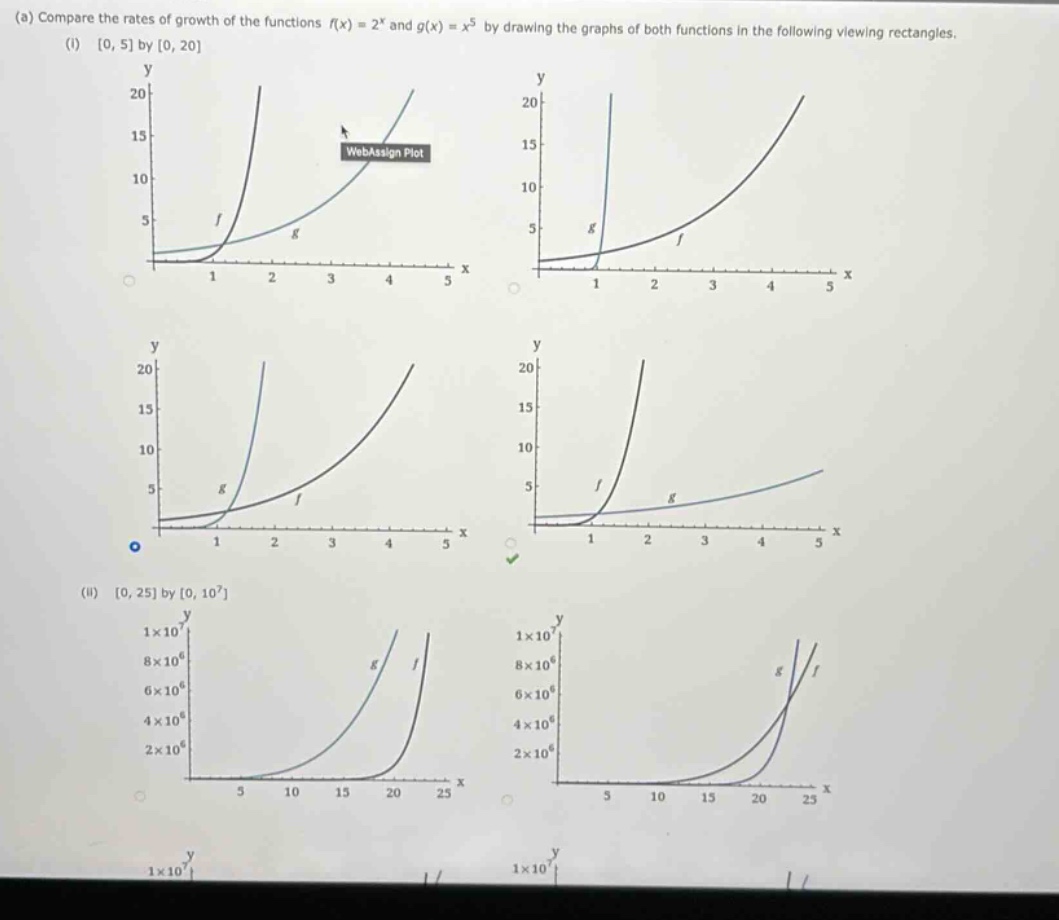
(a) compare the rates of growth of the functions f(x) = 2^x and g(x) = x^5 by drawing the graphs of both functions in the following viewing rectangles. (i) 0, 5 by 0, 20 (ii) 0, 25 by 0, 10^7
Answer
Explanation:
Step1: Analyze the graphs in [0, 5] by [0, 20]
In the viewing - rectangle [0, 5] by [0, 20], for small values of (x) (initially), (x^{5}) grows faster than (2^{x}). But as (x) approaches 5, (2^{x}) starts to catch up.
Step2: Analyze the graphs in [0, 25] by [0, 10^{7}]
In the viewing - rectangle [0, 25] by [0, 10^{7}], as (x) gets larger (beyond a certain point, approximately (x = 17)), the exponential function (y = 2^{x}) grows much faster than the polynomial function (y=x^{5}). The exponential function (y = 2^{x}) will eventually over - take and far surpass the polynomial function (y = x^{5}).
Answer:
For small values of (x) (in the interval [0, 5]), (g(x)=x^{5}) grows faster than (f(x)=2^{x}). But as (x) gets larger (in the interval [0, 25]), (f(x)=2^{x}) grows much faster than (g(x)=x^{5}).