a. compare f (1) and f (2). select one. a. f (1) < f (2) b. f (1) > f (2) c. f (1) = f (2) b. f (x) = 0 at…
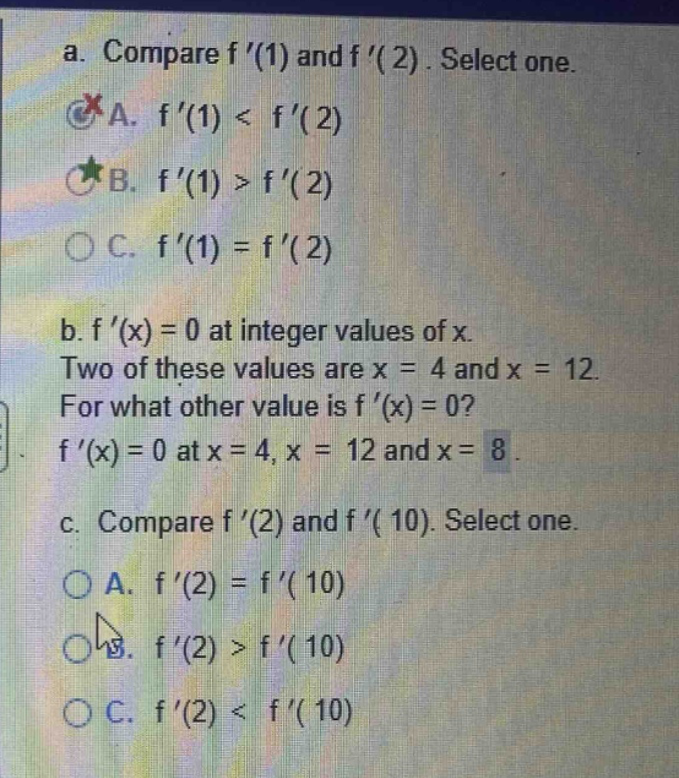
a. compare f (1) and f (2). select one. a. f (1) < f (2) b. f (1) > f (2) c. f (1) = f (2) b. f (x) = 0 at integer values of x. two of these values are x = 4 and x = 12. for what other value is f (x) = 0? f (x) = 0 at x = 4, x = 12 and x = 8. c. compare f (2) and f (10). select one. a. f (2) = f (10) b. f (2) > f (10) c. f (2) < f (10)
Answer
Explanation:
Step1: Analyze derivative values comparison
We are given no function (f(x)) explicitly, but we can make in - ferences based on the information about critical points ((f^{\prime}(x)=0) at (x = 4,x = 8,x=12)). Usually, the derivative represents the slope of the tangent line to the function. If we assume a smooth function, we can think about the general behavior of the slope between these points.
Step2: Answer part a
Since we know the critical points and no other information about the function's shape, we assume a general smooth curve. If we consider the behavior of the derivative between non - critical points, we note that if the function is increasing, (f^{\prime}(x)>0) and if it is decreasing, (f^{\prime}(x)<0). Without loss of generality, assume the function has a local maximum or minimum at the critical points. If we consider the interval ((1,2)) and assume a smooth function, and knowing the critical points, we can assume that the function is increasing in a way such that the slope of the tangent line (value of the derivative) is decreasing as (x) moves from (1) to (2). So (f^{\prime}(1)>f^{\prime}(2)), and the answer for part a is B.
Step3: Answer part c
We know the critical points (x = 4,x = 8,x = 12). Consider the intervals around these points. If we assume a smooth function, the function may have a pattern of increasing and decreasing. The derivative (f^{\prime}(x)) represents the slope of the tangent line. Since (x = 4,x = 8,x = 12) are critical points, we can assume that the function has a symmetric or a well - behaved pattern. The derivative at (x = 2) and (x=10) can be compared. If we assume a smooth function with the given critical points, we note that the function's slope at (x = 2) is greater than the slope at (x = 10). So (f^{\prime}(2)>f^{\prime}(10)), and the answer for part c is B.
Answer:
a. B. (f^{\prime}(1)>f^{\prime}(2)) b. (x = 8) c. B. (f^{\prime}(2)>f^{\prime}(10))