3.4 comparing linear and exponential functions\n$y = 3^x$\n$y = (\\frac{1}{3})^x$\nis this an exponential…
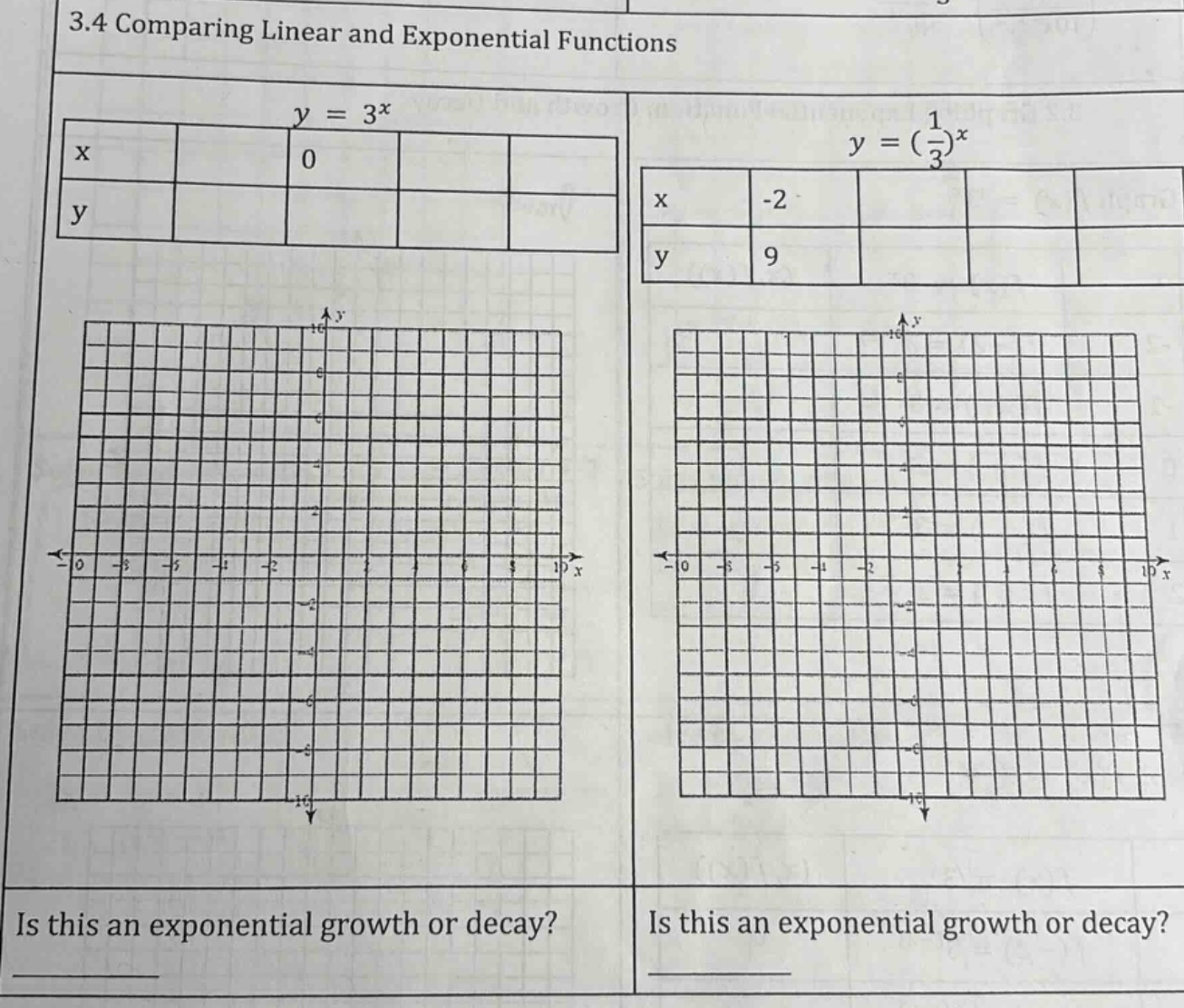
3.4 comparing linear and exponential functions\n$y = 3^x$\n$y = (\\frac{1}{3})^x$\nis this an exponential growth or decay?\nis this an exponential growth or decay?
Answer
Explanation:
Step1: Recall exponential - function rules
For an exponential function (y = a^x), if (a>1), it is exponential growth; if (0 < a<1), it is exponential decay.
Step2: Analyze (y = 3^x)
Here (a = 3), and since (3>1), the function (y = 3^x) is an exponential - growth function.
Step3: Analyze (y=(\frac{1}{3})^x)
Here (a=\frac{1}{3}), and since (0<\frac{1}{3}<1), the function (y = (\frac{1}{3})^x) is an exponential - decay function.
Answer:
For (y = 3^x): Exponential growth For (y = (\frac{1}{3})^x): Exponential decay