comparing rates of change\nwhich function increases at a faster rate on 0 to infinity, $f(x)=x^{2}$ or…
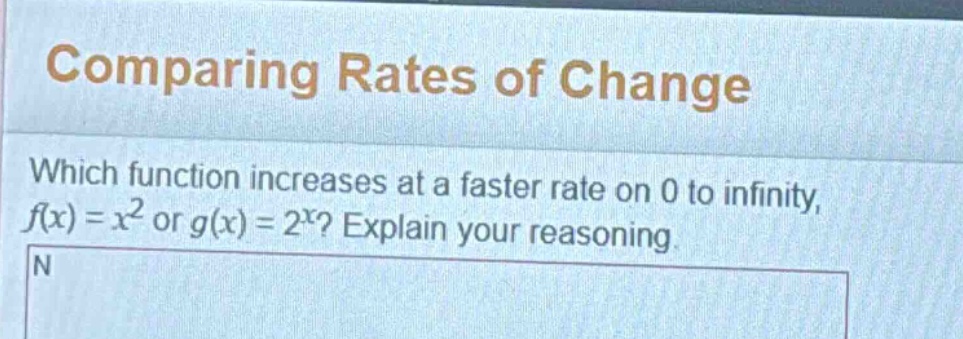
comparing rates of change\nwhich function increases at a faster rate on 0 to infinity, $f(x)=x^{2}$ or $g(x)=2^{x}$? explain your reasoning.
Answer
Explanation:
Step1: Recall rate - of - change concept
The rate of change of a function can be analyzed by looking at its growth behavior. For positive - valued functions, we can compare their values for large values of (x).
Step2: Evaluate the functions at some points
Let's choose some values of (x) in the interval ((0,\infty)). When (x = 2): (f(2)=2^{2}=4) and (g(2)=2^{2}=4) When (x = 3): (f(3)=3^{2}=9) and (g(3)=2^{3}=8) When (x = 4): (f(4)=4^{2}=16) and (g(4)=2^{4}=16) When (x = 5): (f(5)=5^{2}=25) and (g(5)=2^{5}=32)
Step3: Analyze long - term behavior
The function (y = x^{2}) is a polynomial function of degree 2, and the function (y = 2^{x}) is an exponential function with base (a = 2>1). For exponential functions (y = a^{x}(a > 1)) and polynomial functions (y=x^{n}(n>0)), as (x\to\infty), the exponential function (y = a^{x}) will eventually grow faster than the polynomial function (y = x^{n}). We can also use the limit (\lim_{x\to\infty}\frac{2^{x}}{x^{2}}). By L'Hopital's rule (since we have the indeterminate form (\frac{\infty}{\infty})), differentiating the numerator and denominator: The derivative of (y = 2^{x}) is (y'=2^{x}\ln(2)), and the derivative of (y = x^{2}) is (y' = 2x). So (\lim_{x\to\infty}\frac{2^{x}}{x^{2}}=\lim_{x\to\infty}\frac{2^{x}\ln(2)}{2x}). Applying L'Hopital's rule again (still (\frac{\infty}{\infty}) form), the derivative of (2^{x}\ln(2)) is (2^{x}(\ln(2))^{2}) and the derivative of (2x) is 2. So (\lim_{x\to\infty}\frac{2^{x}\ln(2)}{2x}=\lim_{x\to\infty}\frac{2^{x}(\ln(2))^{2}}{2}=\infty).
Answer:
The function (g(x)=2^{x}) increases at a faster rate on the interval ((0,\infty)) because exponential functions with bases greater than 1 grow faster than polynomial functions as (x) approaches infinity.