comparing rates of change\nwhich function increases at a faster rate on 0 to infinity, f(x) = x² or g(x) =…
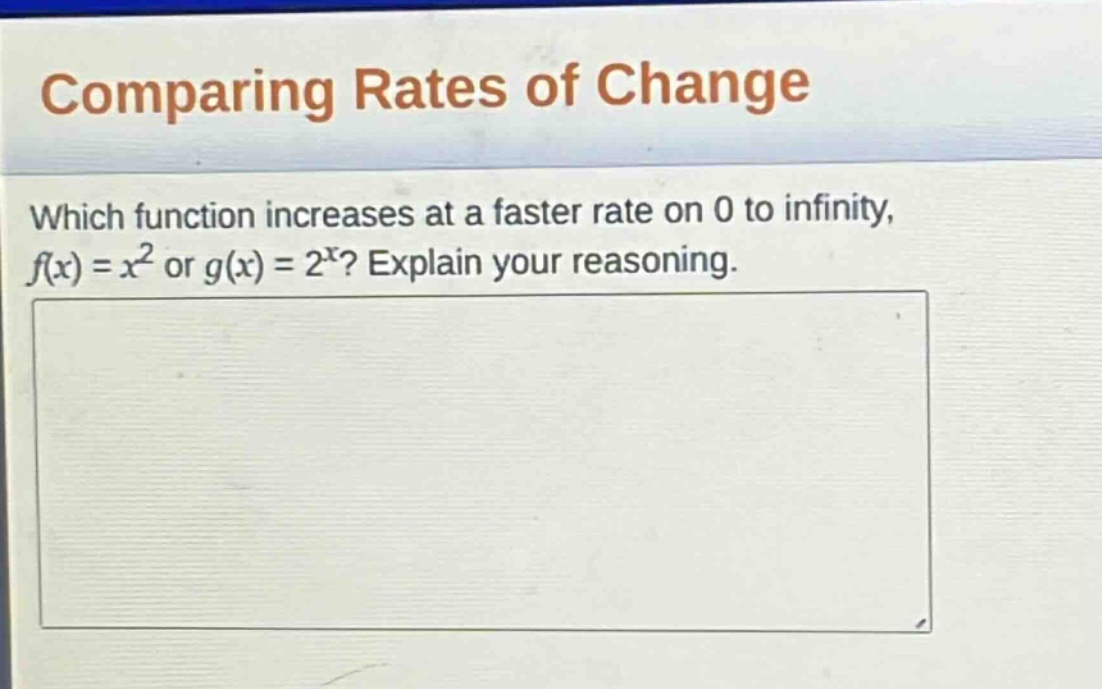
comparing rates of change\nwhich function increases at a faster rate on 0 to infinity, f(x) = x² or g(x) = 2^x? explain your reasoning.
Answer
Explanation:
Step1: Analyze the nature of functions
$f(x)=x^{2}$ is a polynomial function of degree 2, and $g(x) = 2^{x}$ is an exponential - function.
Step2: Consider the growth rate of different function types
Polynomial functions $y = x^{n}$ (where $n$ is a positive integer) have a growth rate that is slower than exponential functions $y = a^{x}$ ($a>1$) as $x\rightarrow+\infty$. As $x$ increases from $0$ to $+\infty$, the exponential function $g(x)=2^{x}$ will eventually grow faster than the polynomial function $f(x)=x^{2}$. We can also check some values: when $x = 2$, $f(2)=2^{2}=4$ and $g(2)=2^{2}=4$; when $x = 3$, $f(3)=3^{2}=9$ and $g(3)=2^{3}=8$; but when $x = 4$, $f(4)=4^{2}=16$ and $g(4)=2^{4}=16$, and when $x = 5$, $f(5)=5^{2}=25$ and $g(5)=2^{5}=32$. As $x$ gets larger, the difference becomes more significant.
Answer:
The function $g(x)=2^{x}$ increases at a faster rate on the interval $0$ to $\infty$ because exponential functions with base $a > 1$ grow faster than polynomial functions as $x$ approaches infinity.