complete the definition of the h(x) so that it is continuous over its domain.\nh(x)=\\begin{cases}x^{3},&x <…
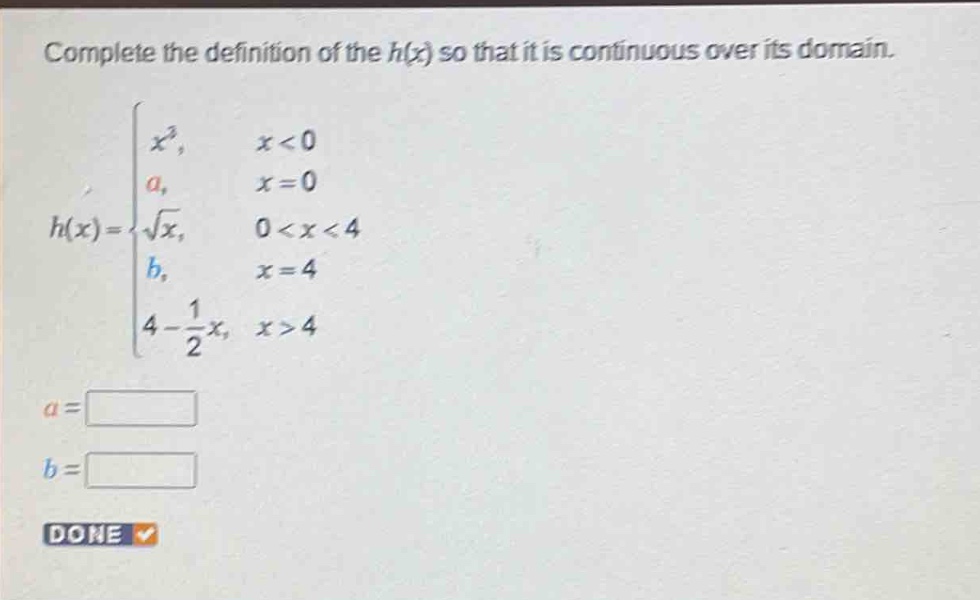
complete the definition of the h(x) so that it is continuous over its domain.\nh(x)=\\begin{cases}x^{3},&x < 0\\\\a,&x = 0\\\\\\sqrt{x},&0 < x < 4\\\\b,&x = 4\\\\4-\\frac{1}{2}x,&x > 4\\end{cases}\na = \\\nb = \\\ndone
Answer
Explanation:
Step1: Find the left - hand limit as x approaches 0
For (x<0), (h(x)=x^{3}). The limit as (x\to0^{-}) is (\lim_{x\to0^{-}}x^{3}=0). For the function to be continuous at (x = 0), the value of the function at (x = 0) must equal the left - hand limit. So (a=\lim_{x\to0^{-}}h(x)). (\lim_{x\to0^{-}}x^{3}=0)
Step2: Find the left - hand and right - hand limits as x approaches 4
For (0 < x<4), (h(x)=\sqrt{x}). The left - hand limit as (x\to4^{-}) is (\lim_{x\to4^{-}}\sqrt{x}=\sqrt{4}=2). For (x > 4), (h(x)=4-\frac{1}{2}x). The right - hand limit as (x\to4^{+}) is (\lim_{x\to4^{+}}(4-\frac{1}{2}x)=4-\frac{1}{2}\times4=4 - 2=2). For the function to be continuous at (x = 4), (b) must equal the left - hand and right - hand limits at (x = 4). (\lim_{x\to4^{-}}\sqrt{x}=2) and (\lim_{x\to4^{+}}(4-\frac{1}{2}x)=2)
Answer:
(a = 0) (b = 2)