8. the complete graph of y = f(x) is shown. a. on what interval(s) is f(x) constant? b. evaluate f(3)-f(-2)…
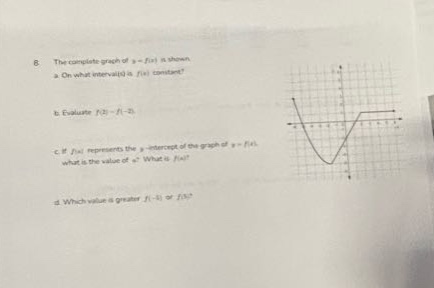
8. the complete graph of y = f(x) is shown. a. on what interval(s) is f(x) constant? b. evaluate f(3)-f(-2). c. if f(a) represents the y - intercept of the graph of y = f(x), what is the value of a? what is f(a)? d. which value is greater, f(-1) or f(5)?
Answer
Explanation:
Step1: Recall continuity definition
A function is continuous on an interval if there are no breaks, jumps or holes. Looking at the graph, $y = f(x)$ is continuous on $(-\infty,\infty)$.
Step2: Find function - values for difference
To find $f(2)-f(-2)$, first find $f(2)$ and $f(-2)$ from the graph. $f(2)$ is the $y$ - value when $x = 2$, and $f(-2)$ is the $y$ - value when $x=-2$. Suppose $f(2)=a$ and $f(-2)=b$, then $f(2)-f(-2)=a - b$.
Step3: Identify y - intercept
The $y$ - intercept occurs when $x = 0$. If $f(x)$ represents the $y$ - intercept of the graph of $y = f(x)$, then we find the value of $y$ when $x = 0$. Let the $y$ - intercept be $c=f(0)$.
Step4: Compare function - values
Find $f(-1)$ and $f(1)$ from the graph. Compare the $y$ - values at $x=-1$ and $x = 1$ to determine which is greater.
Answer:
a. $(-\infty,\infty)$ b. Calculate by finding $f(2)$ and $f(-2)$ from the graph and subtracting. c. The value of $x$ is $0$ and $f(0)$ is the $y$ - intercept value from the graph. d. Compare the $y$ - values of $f(-1)$ and $f(1)$ from the graph.