complete parts (a) and (b) to find all solutions to the equation - sin3x - 1 = 0 in the interval 0, 2π). (a)…
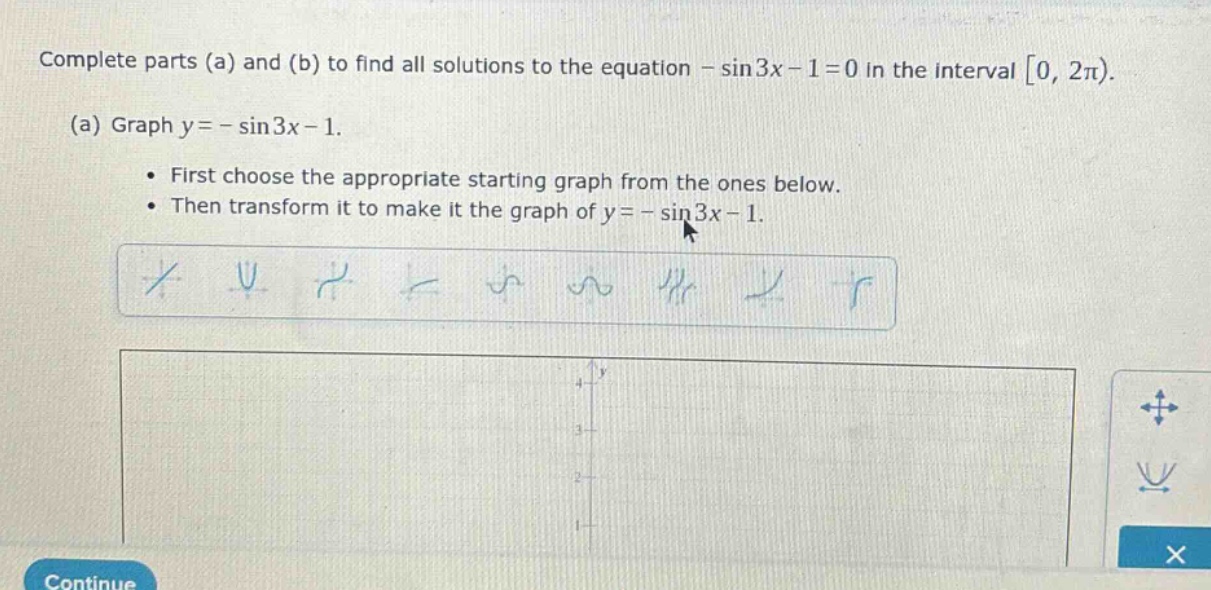
complete parts (a) and (b) to find all solutions to the equation - sin3x - 1 = 0 in the interval 0, 2π). (a) graph y = - sin3x - 1. • first choose the appropriate starting graph from the ones below. • then transform it to make it the graph of y = - sin3x - 1.
Answer
Explanation:
Step1: Recall the basic sine - function properties
The basic sine function is (y = \sin x). The function (y=-\sin3x - 1) is a transformation of the basic sine - function. The general form of a sinusoidal function is (y = A\sin(Bx - C)+D), where for (y =-\sin3x - 1), (A=- 1), (B = 3), (C = 0), and (D=-1).
Step2: Analyze the amplitude
The amplitude of (y = A\sin(Bx - C)+D) is (|A|). Here, (|A| = |-1|=1). The negative sign in front of (\sin3x) reflects the graph of (y = \sin3x) about the (x) - axis.
Step3: Analyze the period
The period of the function (y=\sin(Bx)) is given by (T=\frac{2\pi}{|B|}). For (y = \sin3x), (B = 3), so the period (T=\frac{2\pi}{3}).
Step4: Analyze the vertical shift
The value of (D=-1) shifts the graph of (y =-\sin3x) downward by 1 unit. To graph (y =-\sin3x - 1), start with the graph of (y=\sin x). First, compress the graph horizontally by a factor of 3 to get (y = \sin3x). Then, reflect it about the (x) - axis to get (y=-\sin3x). Finally, shift it downward by 1 unit to get (y =-\sin3x - 1).
To find the solutions of (-\sin3x - 1 = 0) in the interval ([0,2\pi)):
Step5: Solve the equation for (\sin3x)
Starting with (-\sin3x - 1 = 0), we can rewrite it as (\sin3x=-1).
Step6: Find the general solution for (3x)
We know that (\sin\theta=-1) when (\theta=\frac{3\pi}{2}+2k\pi), (k\in\mathbb{Z}). So, (3x=\frac{3\pi}{2}+2k\pi).
Step7: Solve for (x)
Dividing both sides of (3x=\frac{3\pi}{2}+2k\pi) by 3, we get (x=\frac{\pi}{2}+\frac{2k\pi}{3}), (k\in\mathbb{Z}).
Step8: Find the solutions in the interval ([0,2\pi))
When (k = 0), (x=\frac{\pi}{2}). When (k = 1), (x=\frac{\pi}{2}+\frac{2\pi}{3}=\frac{3\pi + 4\pi}{6}=\frac{7\pi}{6}). When (k = 2), (x=\frac{\pi}{2}+\frac{4\pi}{3}=\frac{3\pi+8\pi}{6}=\frac{11\pi}{6}).
Answer:
The solutions of the equation (-\sin3x - 1 = 0) in the interval ([0,2\pi)) are (x=\frac{\pi}{2},\frac{7\pi}{6},\frac{11\pi}{6}).